
Table of Contents
- The claim: this is a home theater hub priced like a home theater hub
- What changed in the Apple TV 4K 2026, from A19 to Wi-Fi 7
- A19 chip: 50% faster CPU, double the GPU performance
- Wi-Fi 7, Gigabit Ethernet and the single 128GB tier
- The evidence: four-HomePod Home Theatre is the only thing the old box cannot do
- How to pair four HomePods, and the matching rules
- What it costs: $299 plus $596 in HomePod mini 2 speakers
- Where HomePod Atmos still trails an up-firing soundbar
- Hands-free Siri and a Siri Remote you can finally find
- $299 against streaming sticks and the platform already in your TV
- The strongest counter-argument: GPU headroom, future tvOS releases and hub duties
- Who should keep the 2022 Apple TV 4K and wait
- What to watch next
- Frequently asked questions
- How much does the new Apple TV 4K cost in 2026?
- Is the $299 Apple TV 4K worth it without HomePods?
- How many HomePods can you pair with the Apple TV 4K for surround sound?
- What does an Apple TV 4K plus four HomePod mini 2 speakers actually cost?
- What is new in the fourth-generation Apple TV 4K?
- Does Siri AI work on older Apple TV 4K models?
- Can I just buy the new Siri Remote instead of the whole box?
- Is HomePod surround sound better than a soundbar?
- Should I keep my 2022 Apple TV 4K?
- Does the Apple TV 4K still work as a smart home hub?
- Limitations of this analysis, and the alternatives worth pricing
- The verdict
- References
- Related Reading
The Apple TV 4K 2026 costs $299 and only earns that price if you build a four-HomePod Home Theatre setup. The price rose from $129 to $299 and now ships in a single 128GB tier. The A19 chip delivers Apple’s claimed 50% faster CPU and double the GPU performance, which reads as headroom rather than a current need. Four-HomePod surround is the one capability the 2022 box cannot match, and reaching it costs roughly $895 with four HomePod mini 2 speakers before tax.
The Apple TV 4K 2026 is a $299 home theater hub priced like one, and the four-HomePod Home Theatre mode is the only feature the 2022 box cannot match. Apple announced the fourth-generation box on October 13, 2026, with retail availability arriving in mid-November 2026, up from a $129 starting price on the previous generation. This review decides two things: who should spend the $299, and who should keep the box already sitting under their television.
About the author: Written by The Tech ABC editorial team, which covers TVs, streaming hardware and home audio with a buyer-first focus — what a device does, what it costs, and how it compares to the obvious alternative. More hardware coverage from The Tech ABC.
Everything You Need to Know About the Nintendo Switch 2
Transparency: The Tech ABC did not receive a review unit of the fourth-generation Apple TV 4K. Performance figures are Apple’s own published claims and are labelled as such. Reviewer observations are attributed to the outlets that published them between November 12 and November 15, 2026. US prices are current as of November 21, 2026 and exclude tax. See our disclaimer.
The claim: this is a home theater hub priced like a home theater hub
The new Apple TV 4K costs $299 because Apple folded a four-speaker wireless audio system and an expanded smart home hub role into a product that previously sold as a streaming box — which means the buying decision is now an audio decision rather than a streaming decision. Nothing in the 2026 model improves the picture you get from Netflix, Max or Apple TV+. The audio chain is where the money goes.
A $170 increase on a streaming box makes sense only when measured against home theater hardware. Therefore the honest comparison set is soundbars and entry-level AV receiver packages, not $50 sticks. PCMag’s coverage of the HomePod mini and Apple TV refresh noted that Apple dropped the cheaper storage tiers entirely, leaving one 128GB configuration — evidence that Apple removed the entry-level buyer from the lineup on purpose.
The numbers that define the decision
>
- $299 — launch price, single 128GB configuration, up from $129 on the previous generation
- October 13, 2026 — announcement date, per Apple Newsroom; retail availability mid-November 2026
- $895 — approximate cost of the box plus four HomePod mini 2 speakers, before tax
What changed in the Apple TV 4K 2026, from A19 to Wi-Fi 7
The specification delta is narrow outside audio and microphones, which is why the whole argument rests on the HomePod feature. The table below sets the two generations side by side; figures come from Apple’s announcement and from the product breakdown published by ecoustics.
| Specification | Apple TV 4K (2022) | Apple TV 4K (2026) |
|---|---|---|
| Chip | A15 Bionic | A19 |
| Storage tiers | 64GB and 128GB | 128GB only |
| Wi-Fi | Wi-Fi 6 | Wi-Fi 7 |
| Wired networking | Gigabit Ethernet on 128GB model | Gigabit Ethernet |
| Built-in far-field microphones | No | Yes |
| Bundled remote | Siri Remote, no Ultra Wideband | Siri Remote with Ultra Wideband |
| Maximum Home Theatre speakers | Two (one stereo pair) | Four (two stereo pairs) |
| Launch price (US) | $129 and up | $299 |
A19 chip: 50% faster CPU, double the GPU performance
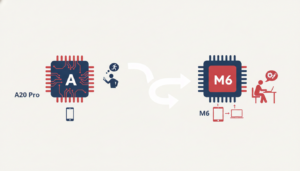
Apple states the A19 replaces the A15 Bionic and delivers a 50% faster CPU with double the GPU performance. Reviewers publishing in mid-November 2026 reported smoother menu animations but no change to streaming playback itself, because 4K Dolby Vision decoding was never the bottleneck on the older box. Consequently the silicon reads as headroom for future tvOS releases rather than a fix for a current problem — the same long-horizon chip strategy visible in Apple’s 5G modem roadmap, where the hardware lands years before the software fully uses it.
Wi-Fi 7, Gigabit Ethernet and the single 128GB tier
Wi-Fi 7 matters here for one reason: four wireless speakers and a Thread and Matter hub share the same radio environment as the video stream, which means link stability directly affects the audio feature Apple is charging for. Wireless coexistence and interference behaviour are exactly what accredited labs such as Micom Labs test for before a device ships, and real-world results depend on how crowded your 5GHz and 6GHz bands already are. The cheaper storage tiers are gone, so the 2026 lineup has no $129 entry point at all.
The evidence: four-HomePod Home Theatre is the only thing the old box cannot do
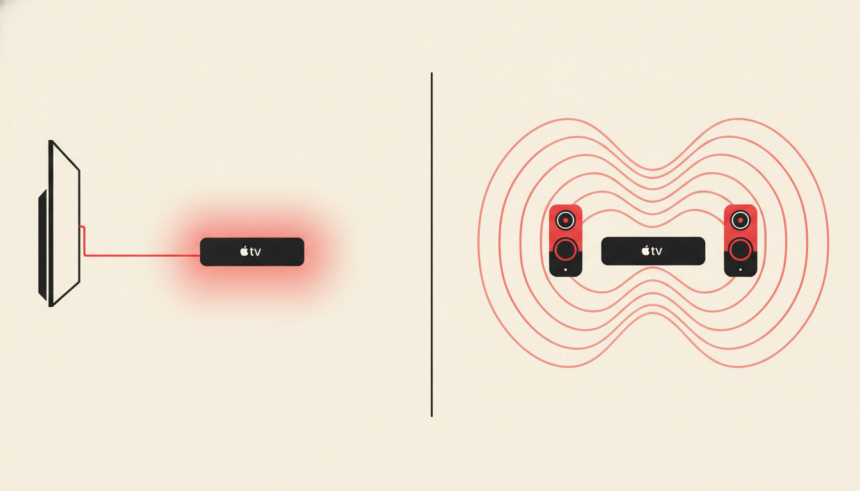
The 2026 box supports up to four paired HomePods in Home Theatre mode, and that capability does not extend to the 2022 model — therefore it stands as the only hardware-locked reason to spend $299. Everything else either arrives on the older box through software or sells separately as an accessory.
Apple’s audio record invites scrutiny before you commit nearly $900 to one ecosystem; the company’s handling of AirPods Pro audio issues is a reminder that wireless audio platforms live and die on firmware support. That caveat aside, four discrete wireless points of sound is a genuine capability jump, not a marketing line.
How to pair four HomePods, and the matching rules
Two rules break most setups: the two front speakers must match each other and the two rear speakers must match each other, which means a HomePod mini 2 cannot be stereo-paired with a full-size HomePod. Every speaker also has to sit on the same Apple Account and the same Wi-Fi network as the box, because Home Theatre routing runs through the Home app rather than the TV’s audio settings.
- Update the Apple TV and every HomePod to the current tvOS and HomePod software release
- Confirm all speakers are signed into the same Apple Account and on the same Wi-Fi network as the box
- Create a stereo pair from the two matching front speakers in the Home app
- Create a second stereo pair from the two matching rear speakers
- Open Apple TV settings, choose Video and Audio, then Audio Output, and select both pairs for Home Theatre
- Assign front and rear roles, then run a test clip with known surround content to verify channel placement
What it costs: $299 plus $596 in HomePod mini 2 speakers
The full build runs roughly $895 before tax. At that total the setup competes with premium Dolby Atmos soundbar packages and entry-level AV receiver bundles, which means Apple is asking buyers to choose an ecosystem rather than a streaming box. Full-size HomePods in place of the mini 2 push the figure higher still.
| Component | Quantity | US price |
|---|---|---|
| Apple TV 4K (2026, 128GB) | 1 | $299 |
| HomePod mini 2 front pair | 2 | ~$298 |
| HomePod mini 2 rear pair | 2 | ~$298 |
| Total before tax | — | ~$895 |
| Premium Dolby Atmos soundbar with wireless surrounds | 1 package | Not stated in sources |
Where HomePod Atmos still trails an up-firing soundbar
Reviewers at The Verge and other outlets publishing between November 12 and November 15, 2026 found the Dolby Atmos height effects through HomePods less convincing than dedicated up-firing drivers, because HomePods render height virtually instead of bouncing sound off the ceiling. The trade runs both ways, though: a single soundbar cannot place rear channels from two physically separate speakers behind the sofa, and four discrete wireless points produce room-filling surround without running speaker cable.
Hands-free Siri and a Siri Remote you can finally find
The 2026 Siri Remote sells separately for $59 and works with older Apple TV 4K models, therefore the remote on its own cannot justify a $299 purchase. It looks identical to the previous version but adds an Ultra Wideband chip for Precision Finding in the Find My app, plus the ability to play a locating sound.
The built-in far-field microphones are genuinely new hardware, and their effect is practical: commands reach the box without you picking anything up, as gajitt’s coverage of the far-field microphone addition describes. Apple is also rolling its updated Siri voice features out to older compatible boxes, which means the software is not the upgrade trigger either. Reviewers noted that voice recognition remains inconsistent in day-to-day use.
iPhone 17 Camera AI Features: Smarter Image Processing
- Far-field microphones in the box — new hardware, requires the 2026 model
- Ultra Wideband Precision Finding in the Siri Remote — available on the $59 standalone remote
- Play-a-sound remote locating through Find My — available on the $59 standalone remote
- Updated Siri voice features in tvOS — also rolling out to older compatible Apple TV 4K boxes
$299 against streaming sticks and the platform already in your TV
For a viewer who only streams, a $50 stick delivers the same 4K Dolby Vision picture from the same apps, so the $299 premium buys interface speed, an ad-free home screen and hub capability — not better video. That is a real difference, but it is a usability difference, not a picture-quality one.
The reason the free option in your television feels slower is commercial: TV makers subsidise their built-in platforms with advertising and data collection, resulting in a promotion-heavy home screen that pushes content you did not ask for. Apple sells hardware instead, which is why its home screen stays clean when you go looking for the best shows to stream on Apple TV+.
This Is Why Photoshop Isn’t Your Only Option Anymore
| Device | US price | Max surround setup | Smart home hub | Ads on home screen |
|---|---|---|---|---|
| Apple TV 4K 2026 | $299 | Four HomePods, two stereo pairs | Yes, Matter and Thread | No |
| Apple TV 4K (2022, stock or used) | $129 and up at launch | Two HomePods, one pair | Yes, Matter and Thread | No |
| Google TV Streamer (4K) | Approx. $100 | HDMI passthrough to soundbar | Yes, Matter and Thread | Promotional rows typical |
| Amazon Fire TV Stick 4K Max | Approx. $50 | HDMI passthrough to soundbar | Not stated | Promotional rows typical |
| Built-in smart TV apps | Included with TV | TV speakers or soundbar | Varies by brand | Promotional rows on most platforms |
The strongest counter-argument: GPU headroom, future tvOS releases and hub duties
The pro-upgrade case deserves its best version. Doubled GPU performance, Wi-Fi 7 and Thread and Matter hub duties together suggest this box stays current across several tvOS releases, so a buyer who replaces hardware once every six years pays roughly $50 a year for the device that runs the entire house — streaming, HomeKit accessories, cameras and audio routing. Judged as infrastructure rather than as a media player, $299 looks defensible.
The rebuttal rests on timing. The 2022 box already handles current tvOS workloads smoothly and is receiving the same updated voice features, therefore the GPU headroom pays off only on software that does not exist yet. Apple’s platform cadence is well documented — each annual release lands with features gated by hardware, as our iOS 18 features and download guide showed on the phone side — and paying $299 today for capability that arrives later is a bet, not a purchase. 9to5Mac made a similar value argument in its coverage, noting that the voice features reaching older boxes removes the most obvious upgrade incentive.
One exception stands up. Households running the Apple TV as the only always-on Thread border router gain real reliability from the newer radios, because accessory response times degrade when the hub shares a congested band with video and audio traffic.
Who should keep the 2022 Apple TV 4K and wait
The upgrade question reduces to one test. If you will pair four HomePods within the next year, buy it; if your audio already runs through a soundbar or an AV receiver, the new box changes nothing you watch or hear, so skip it.
- Buy — the four-HomePod builder who wants wireless surround without running speaker cable
- Buy — the Thread and Matter household where the Apple TV is the only always-on hub
- Skip — the soundbar or AV receiver owner, because audio already bypasses the box entirely
- Skip — the 2022 owner who only streams, since the updated voice features are coming to that box anyway
- Consider — the first-time buyer, who should price a discounted prior-generation box before committing $299
What to watch next
Three variables decide whether $299 looks reasonable for the Apple TV 4K 2026 by spring 2027, and all three are worth tracking alongside our wider tech trends and innovations coverage.
- HomePod bundle pricing — a box-plus-speakers discount through the holiday season would cut the $895 entry cost materially
- Surround setup limits — whether Apple loosens the matching-pair rule to allow mixed HomePod models in one Home Theatre configuration
- tvOS support window — how many more releases the third-generation box receives, which sets the real cost of waiting
Frequently asked questions
How much does the new Apple TV 4K cost in 2026?
The Apple TV 4K 2026 sells for $299 in the United States, in a single 128GB configuration. The previous generation started at $129, so the price rose $170 because Apple added far-field microphones, Wi-Fi 7 and four-speaker Home Theatre support. Apple announced it on October 13, 2026, with retail availability in mid-November 2026.
Is the $299 Apple TV 4K worth it without HomePods?
No, for most buyers. Without HomePods you are paying $299 for the same apps and the same 4K Dolby Vision picture a roughly $50 stick delivers, because four-speaker Home Theatre mode is the only capability the older box cannot match. Interface speed and an ad-free home screen are the remaining gains.
How many HomePods can you pair with the Apple TV 4K for surround sound?
Up to four, arranged as two stereo pairs. The two front speakers must match each other and the two rear speakers must match each other, which means a HomePod mini 2 cannot be stereo-paired with a full-size HomePod. All four must share the same Apple Account and network as the box.
What does an Apple TV 4K plus four HomePod mini 2 speakers actually cost?
Roughly $895 before tax — $299 for the box plus about $596 for four HomePod mini 2 speakers. At that total the setup competes directly with premium Dolby Atmos soundbar packages, therefore it should be judged as home theater hardware rather than as a streaming upgrade.
What is new in the fourth-generation Apple TV 4K?
An A19 chip, built-in far-field microphones, Wi-Fi 7, a single 128GB tier, an Ultra Wideband Siri Remote and four-HomePod Home Theatre support. Apple claims a 50% faster CPU and double the GPU performance against the A15 Bionic in the 2022 model, which reviewers read as headroom for future tvOS releases.
Does Siri AI work on older Apple TV 4K models?
Yes — Apple is rolling the updated Siri voice features out to older compatible boxes. The difference is hardware: older models have no built-in microphones, so commands travel through the remote instead of running hands-free. Consequently the software alone is not a reason to replace a working box.
Can I just buy the new Siri Remote instead of the whole box?
Yes, for $59. The 2026 Siri Remote with Ultra Wideband Precision Finding and a play-a-sound locating function sells separately and works with older Apple TV 4K models. Therefore the remote, which is the change most owners notice daily, cannot justify the $299 purchase on its own.
Is HomePod surround sound better than a soundbar?
Better at surround, weaker at height. Four discrete HomePods place rear channels properly without running speaker cable, but reviewers publishing in mid-November 2026 found Dolby Atmos height effects less convincing than up-firing soundbar drivers, because HomePods render height virtually rather than reflecting sound off the ceiling.
Should I keep my 2022 Apple TV 4K?
Keep it unless you are building a four-HomePod surround setup. The 2022 box runs current tvOS smoothly, receives the same updated voice features and streams identical 4K content, which means the $299 buys a capability most households will never configure. A $59 remote covers the Find My upgrade.
Does the Apple TV 4K still work as a smart home hub?
Yes — it acts as a Matter controller and a Thread border router for HomeKit accessories. The 2026 model adds Wi-Fi 7, which improves link stability when the box simultaneously drives four wireless speakers and a house full of accessories on the same congested radio bands.
Limitations of this analysis, and the alternatives worth pricing
Stated plainly: The Tech ABC did not test a review unit, therefore the 50% CPU and double GPU figures are Apple’s own claims rather than measured results, and the height-effect criticism comes from reviewers publishing between November 12 and November 15, 2026. Manufacturer networking figures are laboratory numbers derived from the standards and measurement framework maintained by bodies including the National Institute of Standards and Technology, not living-room throughput. Wireless surround performance depends on room layout, speaker placement and network congestion, which means your result will differ from any published review.
Prices quoted are US retail as of November 21, 2026, exclude tax, and holiday discounting could change the comparison within weeks.
- A discounted or refurbished 2022 Apple TV 4K, if you only stream
- A premium Dolby Atmos soundbar with wireless rear speakers, for stronger height effects
- Google TV Streamer or Fire TV Stick 4K Max, if interface speed matters more than hub duties
- Your television’s built-in apps, if you need a second-room option rather than a main system
The verdict
One sentence settles it. The Apple TV 4K 2026 is worth $299 to the household building four-HomePod surround, and worth nothing extra to everyone else, because every other improvement either arrives on the old box in software or sells separately for $59.
Two groups should buy: the wireless-surround builder who does not want speaker cable in the walls, and the Thread and Matter household depending on one always-on hub. Everyone else — soundbar owners, receiver owners and anyone who simply streams in 4K — keeps the 2022 box and loses nothing. Read more from The Tech ABC’s hardware coverage.
References
- Apple Newsroom — October 13, 2026 announcement, $299 pricing, single 128GB configuration, Wi-Fi 7 and A19 performance claims (manufacturer source).
- ecoustics — product breakdown used for specification comparison and Home Theatre speaker limits.
- gajitt — reporting on the far-field microphone addition and HomePod pairing behaviour.
- The Verge — review observations published November 12–15, 2026 on Dolby Atmos height effects through HomePods and inconsistent voice recognition.
- 9to5Mac — value analysis of the $299 configuration and the voice features reaching older boxes.
- Micom Labs — accredited wireless test laboratory, cited on interference and coexistence testing for Wi-Fi devices.
- National Institute of Standards and Technology — measurement and standards framework underlying consumer networking performance claims.