
Table of Contents
- Why AI Interviews Changed the Hardware Requirements
- The NPU Threshold: Why 40 TOPS Became the Line
- What 16GB of RAM Actually Buys You
- Cameras: Where Integrated Hardware Still Falls Short
- Gaze Correction and the Honesty Question
- Audio Is the Underrated Priority
- How to Choose: A Practical Buying Framework
- Frequently Asked Questions
- Limitations and What This Analysis Cannot Tell You
- Conclusion
- References
- Related Reading
Key Takeaway: The best laptop for video interviews in 2026 is one with a Neural Processing Unit rated at 40+ TOPS, 16GB of LPDDR5 RAM, and a camera system capable of local gaze correction — because the software evaluating you is now a conversational AI that scores your audio, video and response patterns in real time. Hardware that stutters or throttles mid-answer degrades the exact data the algorithm is grading.
>
- Copilot+ PC minimums (40+ TOPS NPU, 16GB RAM, 256GB SSD) are now the practical floor for smooth AI video calls on Windows 11 24H2.
- Qualcomm Snapdragon X Elite Plus, Intel Core Ultra 200V and AMD Ryzen AI 300 chips offload video AI from the CPU, which prevents thermal throttling during long interviews.
- External AI webcams such as the Insta360 Link 2 Pro and Kandao Focus 4K add tracking and lighting correction that integrated cameras rarely match.
- Audio quality matters more than resolution, because the AI transcribes and scores what it hears before it ever analyses what it sees.
>
Buy for sustained AI processing, not peak benchmark scores — interviews are a thermal endurance test, not a sprint.
Hiring stopped being a conversation between two humans somewhere around 2025. By 2026, enterprise recruitment workflows have largely abandoned one-way recorded video in favour of conversational AI interviewers — avatars and voice agents that listen to your answer, parse the context, and generate a dynamic follow-up question before you have finished exhaling. Platforms like NeoRecruit analyse audio, video, behaviour and response patterns simultaneously to produce auditable risk scores, while established players including HireVue and R1Interview have scaled automated skill-scoring to handle global application volumes.
That changes what a laptop is for. When a human recruiter watched your interview, a slightly soft webcam and a half-second audio dropout were forgivable; a person fills in gaps automatically. An AI scoring engine does not. It transcribes what it receives, scores fluency and framing from what it receives, and has no mechanism for charity. Consequently, the device you sit in front of has become part of your application — which is why the question of the best laptop for video interviews is no longer a trivial purchasing decision.
About the Author: The Tech ABC Editorial Team covers consumer laptops, components and AI-enabled hardware with a buyer-first focus — what a device does, what it costs, and who should actually buy it. Our tech trends and innovations coverage tracks how platform-level shifts like on-device AI change real purchasing advice.
Transparency: This article draws on published hardware standards, platform documentation and 2025–2026 recruitment research cited inline. We have not been compensated by any manufacturer or hiring platform named here. Product specifications reflect publicly stated requirements rather than independent lab testing by The Tech ABC. See our disclaimer for details.
Why AI Interviews Changed the Hardware Requirements
AI interviews raised the hardware bar because the processing moved onto your machine. Real-time gaze correction, background noise suppression, live translation and voice clarity algorithms all run locally on modern Windows laptops rather than in the cloud, which means your silicon — not a distant server — determines whether those effects run cleanly or collapse into artefacts mid-sentence.
The driver behind this is volume. LinkedIn’s 2025 Future of Recruiting report found application volumes grew by roughly 51% in some sectors, making manual screening mathematically impossible at enterprise scale. Employers responded with automation, and Aptitude Research benchmarks indicate AI video interview platforms cut time-to-shortlist from weeks to hours while reducing cost-per-hire by up to 30%. Because the economics work so decisively in the employer’s favour, candidates no longer get to opt out of being measured by a machine.
There is a legitimate tension here, and it is worth stating plainly. Pew Research data indicates roughly 66% of U.S. adults are wary of applying for jobs that use AI in hiring decisions. That scepticism is not irrational: 2026 data shows AI video interview tools can systematically disadvantage non-native speakers, because natural language processing scores of fluency and confidence tend to favour accents matching the model’s primary training data. Better hardware does not fix structural bias. It does, however, remove the self-inflicted penalties — the dropped syllables, the dim backlit face, the frozen frame — that add noise to an already imperfect evaluation.
The NPU Threshold: Why 40 TOPS Became the Line
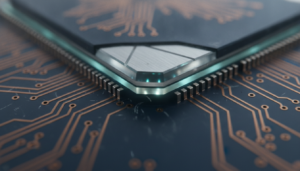
The 40 TOPS figure is the single most useful number in this entire category, because Microsoft’s Copilot+ PC standard uses it as the hard gate for local AI features. A Neural Processing Unit below that threshold cannot sustain the combination of gaze correction, noise suppression and live captioning that AI-era interview software expects, which means those workloads fall back to the CPU and GPU.
That fallback is the real problem. CPUs and GPUs running sustained video AI generate heat, and heat triggers thermal throttling — clock speeds drop, frame rates stutter, and audio buffers slip. A 45-minute conversational AI interview is precisely the kind of sustained load that exposes this. Therefore the NPU is not a luxury feature; it is the component that keeps your presentation stable from minute one to minute forty-five.
| Component | 2026 practical minimum | Why it matters |
|---|---|---|
| NPU | 40+ TOPS | Required for local Copilot+ AI features |
| RAM | 16GB DDR5 / LPDDR5 | Baseline for smooth Windows 11 24H2 AI calls |
| Storage | 256GB SSD | Stated minimum for Copilot+ configurations |
| OS | Windows 11 (24H2) | Platform layer for on-device AI processing |
Three processor families currently dominate this tier: the Qualcomm Snapdragon X Elite Plus, Intel’s Core Ultra 200V series, and AMD’s Ryzen AI 300 series. All three offload AI video processing away from the CPU and GPU specifically to avoid the throttling scenario described above. The practical buying advice is blunt — if a laptop’s spec sheet does not quote an NPU TOPS figure at all, assume it is below the threshold and move on.
What 16GB of RAM Actually Buys You
Sixteen gigabytes is the floor rather than the target, because an AI interview session is not a single application. You are typically running a browser with the interview platform, a video pipeline with AI effects applied, the operating system’s own AI layer, and whatever documents you have open for reference. Each of those claims memory, and when the system runs short it swaps to storage, resulting in the micro-freezes that read to a scoring algorithm as hesitation.
LPDDR5 specifically matters on thin-and-light machines because its higher bandwidth feeds the NPU faster. An NPU starved of memory bandwidth cannot hit its rated throughput, which means a 40 TOPS chip paired with slow memory delivers less than the number on the box.
Cameras: Where Integrated Hardware Still Falls Short
External AI webcams outperform most integrated laptop cameras because they have room for larger sensors and dedicated image signal processors. This is a physics problem that no amount of software can fully solve — a lid thin enough to be attractive cannot house optics large enough to be excellent.
Two 2026 award winners illustrate what the category now offers. The Insta360 Link 2 Pro, a 2026 CES Picks Award winner, is a 4K AI webcam with advanced depth and lighting correction — the latter being disproportionately important when facial-analysis algorithms are reading your expression from a poorly lit home office. The Kandao Focus 4K AI Webcam, which took a 2026 Red Dot Design Award, adds a built-in two-axis gimbal, AI subject tracking and gesture control, keeping you framed even if you shift position or hold up a physical prop during a technical interview.
| Webcam | 2026 recognition | Standout feature |
|---|---|---|
| Insta360 Link 2 Pro | CES Picks Award | 4K with depth and lighting correction |
| Kandao Focus 4K | Red Dot Design Award | 2-axis gimbal with AI tracking |
iPhone 17 Colors: Expected Variants and Themes
The effect of pairing either with a 40+ TOPS laptop is cumulative: the camera delivers a cleaner source image, and the NPU then applies gaze correction and background processing to a better input. Garbage in, garbage out applies to algorithmic scoring as much as to anything else. If you are curious how far on-device camera AI has progressed on mobile, the same image-processing logic now drives iPhone 17 camera AI features.
Gaze Correction and the Honesty Question
Gaze correction redirects your apparent eyeline toward the camera when you are actually looking at the screen. It exists because the camera and the face you are talking to occupy different positions, and without correction every candidate appears to be looking slightly away.
This is where 2026 hardware gets genuinely strange. In October 2026 Microsoft published a patent (US 2026/0341309 A1) for an AI system running locally on devices that edits live speech and redraws the speaker’s lips to match — aimed initially at removing stutters, filler words and translating languages. The existence of that filing demonstrates how heavily processed a “live” feed has already become. Candidates should understand that the video an employer’s AI scores is a reconstruction, not a recording, and that the fidelity of that reconstruction depends on the hardware doing the reconstructing.
Audio Is the Underrated Priority
Audio outranks video resolution in an AI interview, because transcription happens first and scoring depends on it. If the natural language model mishears a technical term, that error propagates into the rubric regardless of how sharp your 4K image was.
Practically, this means prioritising three things:
- A dedicated microphone or quality headset rather than the laptop’s array, which sits far from your mouth and close to the fans.
- NPU-driven noise suppression, which strips keyboard clatter and room reverb locally rather than sending raw audio to the cloud.
- A quiet thermal profile, because a laptop whose fans spin up under AI load injects broadband noise directly into the microphone.
That third point is why fanless or near-fanless Snapdragon X Elite Plus machines have become a credible pick despite their application compatibility history. A silent chassis running AI on an NPU produces cleaner audio than a powerful x86 laptop screaming through a 45-minute call.
How to Choose: A Practical Buying Framework
The best laptop for video interviews is the one that holds its performance steady under a sustained, mixed AI workload — and that is not the same machine a benchmark chart would recommend. Peak single-core scores are irrelevant to a 40-minute conversation. Sustained NPU throughput, thermal headroom and microphone placement are what determine your output.
Work through it in this order:
- Confirm the NPU rating first. Below 40 TOPS, local AI features are compromised, therefore everything downstream suffers.
- Treat 16GB as non-negotiable. 8GB configurations cannot run Windows 11 24H2 AI features alongside a browser-based interview platform comfortably.
- Check sustained, not peak, behaviour. Look for reviews that measure performance after 20+ minutes of load rather than in short bursts.
- Budget for an external webcam. A 4K AI webcam frequently improves your on-screen presentation more than spending the same money on a faster CPU.
- Test your actual setup before the interview. Record yourself for ten minutes in the exact lighting and position you plan to use.
“If a recruiter still has to watch hours of recorded video to verify the AI’s decision, the technology has failed to provide ROI.”
— Industry assessment of 2026 explainable-scoring requirements
Everything You Need to Know About the Nintendo Switch 2
That assessment matters to candidates because it explains why these systems lean so hard on automated signals. The enforcement of NYC Local Law 144 covering automated employment decision tools, alongside implementation of the EU AI Act, has made auditability and bias audits mandatory rather than optional. Platforms must now retain transcripts and provide evidence-backed rubrics — which means your transcript, generated from your audio, through your hardware, becomes the durable legal record of your interview.
Frequently Asked Questions
Do I need a Copilot+ PC to pass an AI video interview?
No. You can complete an AI interview on older hardware, because the platform runs server-side. However, a 40+ TOPS NPU handles gaze correction, noise suppression and captioning locally without throttling, which produces a more stable feed for the scoring engine to evaluate.
Is a MacBook a reasonable choice for AI interviews?
Apple silicon handles video calls well, but the specific 40 TOPS NPU standard and its associated features come from Microsoft’s Copilot+ PC specification for Windows 11 24H2. The research here addresses Windows hardware, so treat Mac guidance as outside its scope.
Does a better webcam genuinely affect my score?
It affects the input. The Insta360 Link 2 Pro and Kandao Focus 4K provide depth, lighting correction and AI tracking that keep your face correctly exposed and framed, which gives facial-analysis algorithms cleaner data. Clean data reduces avoidable misreadings.
Should I use AI features that alter my appearance or speech?
Gaze correction and noise suppression are standard platform features. Microsoft’s October 2026 patent for live speech editing and lip redrawing shows where this is heading, but candidates should consider employer policies and disclosure expectations before enabling anything that materially alters their presentation.
How much RAM do I actually need?
16GB of DDR5 or LPDDR5 is the stated 2026 baseline for running Windows 11 24H2 Copilot+ features smoothly during a video call. Less memory forces swapping to storage, resulting in stutters that interrupt your delivery.
Will better hardware offset AI bias against my accent?
No, and it is important to be clear about this. 2026 data shows NLP fluency scoring can disadvantage non-native speakers structurally. Better audio hardware improves transcription accuracy, which helps — but it does not address the underlying model bias.
Limitations and What This Analysis Cannot Tell You
Research limitations: The hardware thresholds cited here come from published platform standards and award recognitions rather than independent testing of interview-specific workloads. No publicly available study measures whether a 40+ TOPS NPU improves actual AI interview scores, because scoring rubrics are proprietary and platforms do not release candidate-level hardware data. The causal link between hardware quality and outcome is therefore inferential — stronger hardware produces cleaner input, and cleaner input is what scoring engines consume.
Alternative approaches: Spending on hardware is not the only path. A wired ethernet connection, a well-positioned lamp, and a quiet room frequently improve an interview feed more than a processor upgrade, and cost considerably less. Candidates on a budget should exhaust environmental fixes before buying silicon. A capable external webcam plus a headset attached to an older machine is a defensible alternative to replacing the laptop entirely.
This Is Why Photoshop Isn’t Your Only Option Anymore
Professional consultation: Legal questions about automated employment decision tools — including your rights under NYC Local Law 144 or the EU AI Act, and whether you can request human review or accommodation — require qualified employment law advice specific to your jurisdiction. Nothing here constitutes legal guidance.
Conclusion
The shift from recorded video to conversational AI interviewers moved the burden of production quality onto the candidate, because the evaluator no longer compensates for poor input. Consequently, the 2026 specification sheet that matters is narrow and specific: a 40+ TOPS NPU from the Snapdragon X Elite Plus, Core Ultra 200V or Ryzen AI 300 families, 16GB of LPDDR5, a 256GB SSD, and ideally an external AI webcam handling the optics that a thin laptop lid cannot.
None of that makes you a better candidate. It makes you a more accurately represented one — which, when 66% of U.S. adults already distrust AI in hiring and NLP scoring demonstrably penalises some accents, is the only part of the system you actually control. Choose for sustained performance under load, fix your lighting and audio first, and recognise that the best laptop for video interviews is simply the one that stays out of the way while you answer.
Read more from our AI coverage for ongoing analysis of how on-device AI is reshaping the hardware people buy.
References
- LinkedIn, 2025 Future of Recruiting — application volume growth of roughly 51% in some sectors
- Aptitude Research — AI video interview benchmarks on time-to-shortlist and cost-per-hire reduction
- Pew Research Center — U.S. adult attitudes toward AI in hiring decisions
- Microsoft — Copilot+ PC hardware standard and Windows 11 24H2 AI requirements
- Microsoft patent US 2026/0341309 A1, published October 2026 — local AI live speech editing and lip redrawing
- NeoRecruit — adaptive AI avatar interviewing and auditable risk scoring
- R1Interview — enterprise automated skill-scoring and compliance
- Humanly — AI recruitment workflow analysis
- TechPowerUp — NPU and processor specification reporting
- HackerEarth — technical interview assessment practices
- NYC Local Law 144 and EU AI Act — automated employment decision tool compliance requirements