
Table of Contents
- Samsung Galaxy Card vs Apple Card: The 30-Second Verdict
- Hardware Rewards Showdown: 5% vs 3% (and the 6% Asterisk)
- Samsung Galaxy Card Explained: Barclays, Visa and the $200 Bonus
- Apple Card in Late 2026: New Issuer, Aggressive Counter-Promo
- Beyond Hardware: Wallet Rewards, Streaming and Everyday Spend
- Financing and Banking Integration: Where Apple Still Wins
- Fees, APR and Approval Odds
- Who Should Buy Which Card
- Frequently Asked Questions
- Limitations, Alternatives and What This Comparison Cannot Tell You
- The Verdict: Rate Advantage vs Ecosystem Advantage
- References
- Related Reading
Key Takeaway
>
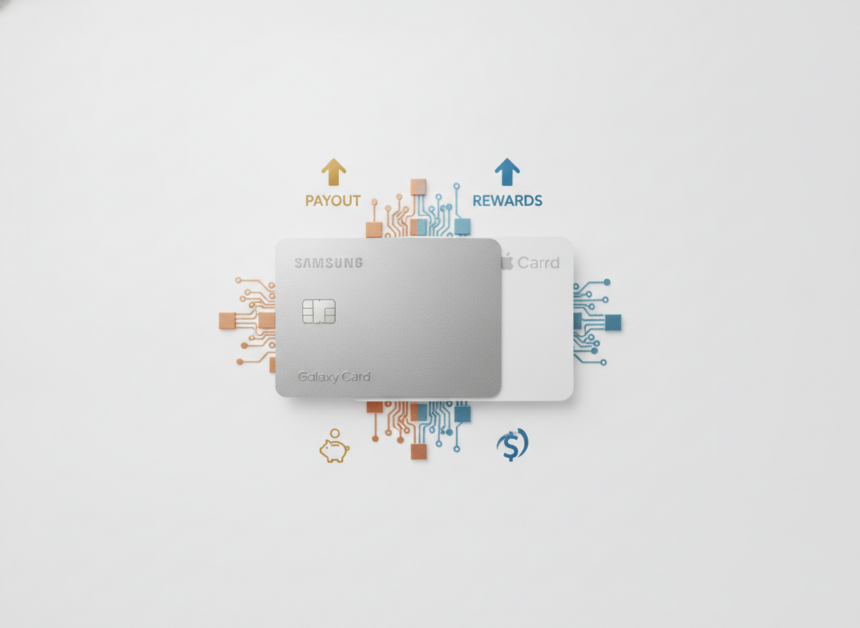
In the samsung galaxy card vs apple card matchup, Samsung wins on standard rates: 5% cash back on direct Samsung hardware and 3% on all Samsung Wallet purchases, versus Apple’s 3% on Apple hardware and 2% through Apple Pay. On a $1,200 device that is $60 back versus $36. The exception is Apple’s double Daily Cash promotion: new applicants who apply by December 12, 2026 earn 6% on Apple hardware for one year, capped at $1,000 total.
Samsung entered the US credit card market on July 22, 2026, and the effect was immediate — Apple lost its monopoly on ecosystem-linked cash back for the first time since 2019. That is why the samsung galaxy card vs apple card question suddenly matters: two of the largest hardware companies on earth are now bidding for the same wallet with real percentage points. The Galaxy Card, issued by Barclays US Consumer Bank on the Visa network, arrived with a 5% first-party hardware rate that undercut Apple’s long-standing 3%. Apple responded on November 18, 2026 by doubling Daily Cash for new applicants, with a hard application deadline of December 12, 2026.
This comparison runs the dollar-for-dollar math on an identical purchase price, lays out the fee structures and APR realities, explains what the Apple Card’s issuer change means for new applicants, and finishes with a single recommendation per buyer type.
About the Author
>
Written by The Tech ABC Editorial Team, which covers consumer hardware and the financing products attached to it — smartphones, laptops, consoles and the payment systems buyers use to acquire them. Our card analysis is built from issuer disclosures, manufacturer newsrooms and independent consumer-finance desks rather than affiliate marketing copy.
Transparency
>
This article is journalism, not financial advice. Rates, promotions, caps and deadlines reflect published terms as of November 19, 2026 and change without notice. We hold no position in Samsung, Apple, Barclays or JPMorgan Chase, and nothing here should be read as a prediction of your approval odds, credit line or APR. See our editorial disclaimer for full details.
Samsung Galaxy Card vs Apple Card: The 30-Second Verdict
On standard published rates, the Samsung Galaxy Card pays more on hardware (5% versus 3%) and more on mobile wallet spend (3% versus 2%), therefore it is the stronger long-term tech rewards card for most buyers. Samsung priced those rates aggressively because Barclays needed a hook sharp enough to break Apple’s seven-year head start in the category, and percentage points were the cheapest hook available.
That verdict flips for new Apple Card applicants inside the double Daily Cash window. A promotional 6% on Apple hardware through the first year beats Samsung’s 5% outright — but only until the $1,000 total cash-back cap or the twelve-month term is reached, whichever arrives first. Because the cap counts all promotional cash back rather than hardware alone, a heavy everyday spender can exhaust it long before the year ends.
The structural tiebreaker sits outside the rate sheet. Apple still owns the better money software, because Daily Cash lands directly in the built-in Apple Savings account without the cardholder lifting a finger, which means the decision is partly a question of which phone is already in your pocket.
The bottom line in three lines
- Buying Samsung hardware: Galaxy Card, because 5% plus a $200 bonus after $2,000 in 90 days beats every Apple rate outside the promo
- Buying Apple hardware before December 12, 2026: Apple Card, because the 6% promotional Daily Cash is the highest first-party hardware rate currently available
- Buying Apple hardware after the promo expires: the gap narrows to 3% versus 5%, so the Galaxy Card wins on math and the Apple Card wins on integration
Hardware Rewards Showdown: 5% vs 3% (and the 6% Asterisk)
The rates are straightforward. The Galaxy Card returns 5% on eligible purchases made directly with Samsung, a category that includes Galaxy phone pre-orders, TVs and home appliances. The Apple Card returns 3% Daily Cash on purchases made directly with Apple, spanning iPhone, Mac, iPad, Apple Watch and Apple services.
| Card / rate | Hardware rate | Cash back on $1,200 | Cap or limit |
|---|---|---|---|
| Samsung Galaxy Card — direct Samsung purchases | 5% | $60 | No published cap |
| Apple Card — direct Apple purchases | 3% | $36 | No published cap |
| Apple Card — double Daily Cash promo (new applicants) | 6% | $72 | $1,000 total, first year only |
| Either card — third-party retailer instead of first party | Base rate applies | Not stated | Varies by payment method |
Run the identical price through both and the gap becomes concrete. A $1,200 Galaxy Z Fold purchased on Samsung’s own storefront returns $60 on the Galaxy Card. A $1,200 iPhone Pro Max — whichever of the current iPhone 17 colors and variants you pick — returns $36 on the standard Apple Card, and $72 under the double Daily Cash promotion. The consequence is narrow but real: Apple’s promotional rate outvalues Samsung’s permanent rate advantage only inside the first year, and only up to $1,000 in total promotional cash back.
That cap deserves modelling before you apply. Because the $1,000 ceiling applies to total promotional cash back rather than hardware purchases alone, a cardholder putting substantial everyday spend through Apple Pay will hit the limit well short of twelve months and revert to 3%. The promotion is therefore worth more to a buyer making one large hardware purchase than to a high-volume spender who would burn the cap on groceries.
iPhone 17 Camera AI Features: Smarter Image Processing
A few secondary perks shift the hardware math further. Samsung attaches a 20% discount on Samsung VIP Advantage memberships plus 5% back when buying or renewing one, which compounds for households already paying for extended device support. Apple’s 3% rate extends beyond hardware into services such as Apple TV+ and iCloud+, which means subscription-heavy Apple users earn the top rate on recurring spend rather than only on upgrade years. Tom’s Guide, reviewing the Galaxy Card at launch in July 2026, concluded it “takes aim at Apple Card with way more perks and rewards,” singling out the blanket 3% Samsung Wallet return as the competitive differentiator rather than the hardware rate itself (Tom’s Guide).
Samsung Galaxy Card Explained: Barclays, Visa and the $200 Bonus
Samsung launched the Galaxy Card on July 22, 2026, issued by Barclays US Consumer Bank on the Visa network, shipping as a black metal physical card with rewards wired directly into Samsung Wallet (Samsung Mobile Press). It is Samsung’s first US credit card, and the rate card was built around first-party channels from day one.
| Specification | Detail |
|---|---|
| Launch date | July 22, 2026 |
| Issuer and network | Barclays US Consumer Bank, Visa |
| Direct Samsung purchase rate | 5% |
| Samsung Wallet rate | 3% |
| Streaming rate | 2% (Netflix, Disney+, Spotify) |
| Physical card rate | 1% |
| Sign-up bonus | $200 after $2,000 in purchases in 90 days |
| Annual fee / foreign transaction fee | $0 / none |
The choice of Barclays and Visa carries practical consequences. Visa acceptance runs broader than the Mastercard-based Apple Card in several overseas markets, which matters for travellers. More importantly, Barclays underwrites the account rather than Samsung, which means servicing, disputes and credit decisions sit with a bank that has no commercial stake in your next phone upgrade — a cleaner separation than the marketing suggests.
The sign-up bonus is calibrated to the buyer this card targets: $200 after $2,000 in purchases within 90 days. A single flagship phone plus a tablet clears that threshold in one checkout, therefore the bonus is realistically reachable for anyone who opened the card for hardware reasons in the first place. Stacked on a $2,000 Samsung hardware run at 5%, the first-year return reaches $300 on that spend alone.
The drawbacks are equally concrete. The physical card earns 1%, which means every transaction made outside Samsung Wallet or Samsung.com delivers a below-market return — and 1% is beaten by dozens of no-fee flat-rate cards.
Where the Galaxy Card falls short
WhatsApp Chats at Stake: Apple Exposes Meta’s Bold Requests!
- 1% on physical card swipes, which penalises any merchant that does not take Samsung Wallet
- Rewards redeem to statement credit, gift cards or an external bank transfer, with no integrated savings account
- Top rates are locked to first-party Samsung channels, so retailer purchases of Galaxy hardware earn the base rate
- No published 0% promotional APR on general spend — special financing is limited to eligible Galaxy devices
Apple Card in Late 2026: New Issuer, Aggressive Counter-Promo
The Apple Card still works normally, but its issuer is changing: Goldman Sachs exited consumer credit, and JPMorgan Chase is taking over the portfolio in a transition running through 2027 (MacRumors). Nothing about the rewards structure or Apple Wallet integration has been withdrawn as a result.
The consequence for cardholders sits in the plumbing rather than the perks. Issuer transitions of this scale typically bring new statement interfaces, new dispute workflows and re-underwritten account terms, which means anyone opening an Apple Card now signs up with one bank and finishes the year with another. That is not a reason to avoid the card, but it is a reason to read the terms you are mailed in 2027 rather than assuming continuity.
Apple Card timeline: 2025 to 2027
- Goldman Sachs announces its retreat from consumer credit, putting the Apple Card portfolio in play
- JPMorgan Chase is confirmed as incoming issuer, with the migration scheduled to run through 2027
- July 22, 2026 — Samsung Galaxy Card launches with 5% hardware rewards and a $200 bonus
- November 18, 2026 — Apple launches double Daily Cash for new applicants, capped at $1,000 for the first year
- December 12, 2026 — final day to apply for the double Daily Cash offer
- Through 2027 — Apple Card accounts complete the move to Chase servicing
The promotion itself is precisely bounded. Apple launched double Daily Cash on November 18, 2026 for new applicants, running for the first year after approval, capped at $1,000 in total cash back, with applications closing December 12, 2026. AppleInsider framed the timing bluntly: Apple moved to maintain acquisition momentum and counter market fatigue as competitors like Samsung dangled $200 sign-up bonuses (AppleInsider). The cause is visible in the calendar — Samsung published a 5% hardware rate in July, and Apple doubled its own rate four months later.
If you are weighing which Apple hardware justifies spreading over 24 months of Apple Card Monthly Installments, the arithmetic favours devices you will still be using when the final payment clears, which is why iPhone 17 battery life is a more useful financing input than the headline chip benchmark.
On durability: a one-year, capped promotion is a customer-acquisition tool, not a permanent repricing. Readers deciding whether to keep the card past year one should therefore model it at 3%, because that is the rate the account reverts to once the promotional term or the $1,000 cap expires.
Beyond Hardware: Wallet Rewards, Streaming and Everyday Spend
You buy a phone once every two or three years, but you buy groceries weekly — therefore the 3% versus 2% mobile wallet difference compounds into far more money than the hardware rate ever will. This is the category where the Galaxy Card builds its real lead, and it is the one most comparisons underweight.
| Spending category | Samsung Galaxy Card | Apple Card |
|---|---|---|
| First-party hardware and services | 5% | 3% |
| Mobile wallet (Samsung Wallet vs Apple Pay) | 3% | 2% |
| Select partner merchants | Not stated | 3% at select merchants |
| Streaming subscriptions | 2% (Netflix, Disney+, Spotify) | 1% |
| Physical card purchases | 1% | 1% |
| Everything else | 1% | 1% |
Quantify the gap and it stops looking like a rounding error. On $2,000 of monthly tap-to-pay spend, 3% returns $720 a year against $480 at 2% — a $240 annual difference that dwarfs the $24 spread on a single $1,200 device. Over a three-year upgrade cycle, the wallet rate decides roughly $720 while the hardware rate decides $24.
The caveat is equally important, and CNBC Select’s September 2026 analysis stated it plainly: earning 3% on all Samsung Wallet purchases is genuinely valuable because NFC terminals are now ubiquitous, but Samsung Pay is not accepted everywhere, and the physical card’s 1% return is a real drawback (CNBC Select). Every transaction that falls back to the metal card drops from 3% to 1%, which means your effective blended rate depends entirely on your local merchant mix rather than on the rate sheet.
Everything You Need to Know About the Nintendo Switch 2
Both wallets share one underappreciated advantage. Because tokenisation standards developed through NIST replace the underlying card number with a device-specific token, neither Samsung Wallet nor Apple Pay transmits your actual account number to the merchant, which reduces exposure when a retailer’s systems are breached. The streaming advantage is smaller but additive: 2% on Netflix, Disney+ and Spotify on the Galaxy Card against 1% on the Apple Card works out to a handful of dollars annually on a typical $60 monthly subscription stack — worth counting toward total household return, not worth choosing a card over.
Financing and Banking Integration: Where Apple Still Wins
Apple’s edge is automation. Daily Cash deposits automatically into the built-in Apple high-yield savings account, which means rewards begin earning interest the day they are earned without any action from the cardholder. SamMobile’s August 2026 ecosystem analysis reached the same conclusion from the Samsung side: Samsung beats Apple on raw hardware cash-back percentages, while Apple retains a clear advantage in financial software integration (SamMobile).
Samsung’s redemption route is more manual. Galaxy Card rewards come back as statement credit, gift cards or a transfer to an external bank, so the balance sits idle until the holder moves it — and behavioural friction consistently reduces how much of any reward balance actually reaches savings. It is also worth understanding the hidden dangers of storing money in payment apps before treating either wallet balance as a substitute for an insured deposit account.
The financing tools diverge in integration rather than generosity. Apple Card Monthly Installments spreads Apple hardware across fixed 0% interest terms directly inside the Wallet app, surfacing at the moment of purchase. Samsung offers special financing on eligible Galaxy devices through Barclays, structured as a promotional financing plan with terms set at checkout. The practical difference is where the decision happens: Apple’s option is part of the buying flow, Samsung’s is a separate promotional arrangement you opt into.
Both cards also lean on tokenisation and virtual card numbers to limit fraud exposure, and CISA guidance on protecting payment credentials applies equally to either — most losses still begin with a convincing message rather than a compromised chip, which is why recognising Apple ID scam warning signs protects a card balance more reliably than any card feature.
The balanced verdict: Apple loses on rate and wins on software. Therefore iPhone owners who will genuinely use Apple Savings can justify the 2% lower hardware return as a convenience cost rather than an error — provided they actually leave the Daily Cash there to earn.
Fees, APR and Approval Odds
Neither card charges an annual fee and neither charges foreign transaction fees, therefore the only meaningful cost of ownership is interest on a carried balance.
| Term | Samsung Galaxy Card | Apple Card |
|---|---|---|
| Annual fee | $0 | $0 |
| Foreign transaction fee | None | None |
| Purchase APR type | Variable | Variable |
| Promotional financing | Eligible Galaxy devices | Apple Card Monthly Installments, 0% |
| Typical credit profile targeted | Good to excellent | Good to excellent |
| Issuer | Barclays US Consumer Bank | Goldman Sachs, transitioning to JPMorgan Chase |
That shared fee structure matters more than any rate difference, because a variable APR running from the high teens into the high twenties — the standard range for no-annual-fee rewards cards, per NerdWallet‘s card analysis — erases 5% cash back within weeks. Carry $1,200 for a year at 25% and you pay roughly $300 in interest to collect $60 in rewards. Both cards only pay you back if the statement balance is cleared monthly; that is arithmetic, not caution.
On approval, both products are marketed to applicants with good to excellent credit, and neither issuer publishes a hard cutoff. Barclays and the Apple Card’s incoming issuer weigh income, existing debt and recent credit applications alongside score, so no single number functions as a threshold. The Apple Card’s migration to JPMorgan Chase adds a further layer of uncertainty to underwriting criteria across 2026 and 2027, because incoming issuers routinely reassess risk models on a portfolio they did not originate.
There is a timing consequence specific to hardware buyers. Applying for a card in the same week you intend to pre-order a flagship phone risks approval with a credit line too small to absorb the purchase, which defeats the entire point of opening the account. Apply at least one statement cycle ahead.
Check these before you apply
- Confirm your credit report is clean and your utilisation is low, because both cards target good-to-excellent profiles
- Decide whether you will clear the balance monthly, because interest outruns 5% cash back quickly
- Check whether your regular merchants accept Samsung Wallet, since fallback swipes earn only 1%
- Time the application at least one statement cycle before a large hardware purchase so the credit line is in place
- If you want the double Daily Cash offer, note the December 12, 2026 application deadline
Who Should Buy Which Card
The right card follows your hardware pipeline and your wallet habits, not the headline percentage.
Pick your profile
- The Galaxy upgrader who pre-orders a flagship and a TV in the same year: Galaxy Card — 5% hardware plus the $200 bonus after $2,000 in 90 days
- The iPhone owner buying a Mac or iPhone before December 12, 2026: Apple Card — 6% promotional Daily Cash up to the $1,000 cap
- The tap-to-pay everyday spender who rarely buys hardware: Galaxy Card — 3% on all Samsung Wallet purchases beats 2% through Apple Pay
- The reader who wants rewards to earn interest automatically: Apple Card — Daily Cash deposits straight into Apple Savings
- The reader who carries a balance: neither — a low-APR or 0% balance transfer card costs less than any cash-back rate pays
Mixed households are the interesting case. Readers who buy Galaxy phones and Apple tablets get the stronger blended return from the Galaxy Card, because its 3% Samsung Wallet rate applies to all spend regardless of where it lands, whereas Apple’s top rate applies only inside Apple’s own channels. The asymmetry is deliberate: Samsung bought breadth, Apple defended depth. Both are using credit products as retention infrastructure, which is one of the clearer tech trends and innovations of 2026 — the card is no longer a payment method, it is a switching cost.
Frequently Asked Questions
Which pays more on hardware, the Samsung Galaxy Card or the Apple Card?
On standard rates, the Galaxy Card pays more. In the samsung galaxy card vs apple card comparison, Samsung returns 5% on direct Samsung purchases against Apple’s 3% — $60 versus $36 on a $1,200 device. The exception is Apple’s 6% promotional Daily Cash for new applicants who apply by December 12, 2026, which temporarily reverses the result up to a $1,000 cap.
How much cash back does the Samsung Galaxy Card give on Samsung purchases?
5% on eligible purchases made directly with Samsung, including Galaxy phone pre-orders, TVs and home appliances. Beyond that, the card returns 3% on all Samsung Wallet purchases, 2% on streaming services such as Netflix, Disney+ and Spotify, and 1% on physical card transactions. New cardholders also earn a $200 bonus after $2,000 in purchases within 90 days.
Is the Apple Card still worth it in 2026?
Yes for Apple-centric buyers, particularly during the current promotion. The 6% promotional Daily Cash through the first year, capped at $1,000, is the highest first-party hardware rate currently available, and Daily Cash deposits automatically into Apple Savings. Qualify it, though: the standard rate reverts to 3%, which trails Samsung’s 5%, and the card is mid-transition to JPMorgan Chase.
Who issues the Samsung Galaxy Card?
Barclays US Consumer Bank, on the Visa network. The card launched July 22, 2026 as Samsung’s first US credit card and ships as a black metal card. Day-to-day management runs through Samsung Wallet, while Barclays handles underwriting, statements and disputes.
When does Apple’s double Daily Cash offer end?
Applications must be submitted by December 12, 2026. The offer launched November 18, 2026 and doubles Daily Cash for the first year after approval, capped at $1,000 in total cash back. Reaching that cap ends the promotional rate early, so heavy spenders should expect to revert to standard rates before the twelve months elapse.
Does the Samsung Galaxy Card have an annual fee?
No — the Galaxy Card charges $0 annually and no foreign transaction fees. The Apple Card matches on both counts, therefore fees are not a differentiator between these two tech cards. The real cost sits elsewhere: interest on a carried balance erases cash back faster than either rate earns it.
What credit score do you need for the Samsung Galaxy Card or Apple Card?
Neither issuer publishes a hard minimum, but both products are marketed to applicants with good to excellent credit. Barclays and the Apple Card’s incoming issuer, JPMorgan Chase, weigh income, existing debt and recent applications alongside score, which means no single number functions as a cutoff and no approval outcome can be assumed in advance.
Can you use the Samsung Galaxy Card outside of Samsung purchases?
Yes — it is a standard Visa card accepted anywhere Visa is. The rate structure drives the value: 3% on anything paid through Samsung Wallet, 2% on streaming subscriptions, 1% on physical card swipes. Consequently the card’s worth depends on how often your local merchants accept Samsung Wallet, because fallback transactions drop to 1%.
Why is JPMorgan Chase taking over the Apple Card?
Because Goldman Sachs exited consumer credit, leaving the Apple Card portfolio without an issuer. Chase is absorbing the accounts in a transition running through 2027, which means cardholders should expect changes to statement interfaces and servicing, and possibly to terms. The rewards structure and Apple Wallet integration continue operating as before.
Which tech credit card is better for a $1,200 phone purchase?
It depends on which phone. A $1,200 Galaxy device returns $60 on the Galaxy Card at 5%. A $1,200 iPhone returns $36 at Apple’s standard 3%, or $72 at the 6% promotional rate for new applicants approved under the current offer. Buying the same phone from a third-party retailer earns only the base rate on either card.
Limitations, Alternatives and What This Comparison Cannot Tell You
Every rate, cap and deadline here reflects published terms as of November 19, 2026. Credit card promotions are revised without notice, and Apple’s issuer migration to JPMorgan Chase runs through 2027, which means terms could be adjusted mid-transition. Verify current rates with the issuer before applying.
This comparison also cannot tell you what you will personally be offered. Individual APRs, credit limits and approval decisions are set by the issuer per applicant, based on data no article has access to, so treat every figure here as the published offer rather than your offer.
The honest alternatives deserve naming. A flat 2% cash-back card on every purchase frequently beats both ecosystem cards for anyone who buys hardware infrequently or shops at retailers rather than first-party stores, because a guaranteed 2% everywhere outperforms 1% on most transactions plus 5% once every three years. A 0% intro APR card is the cheaper instrument for anyone who intends to carry a device balance for months.
Alternatives worth weighing
- A flat 2% cash-back card — better for buyers who rarely purchase first-party hardware
- A 0% intro APR card — cheaper than any cash-back rate if the device balance will be carried for months
- Manufacturer-direct installment plans — sometimes bundle trade-in credit that exceeds a 5% rebate
- Carrier financing — occasionally pairs device credits that no credit card rate can match
The caution that overrides everything above: rewards percentages are marketing, interest is arithmetic, and the arithmetic wins. Readers currently carrying debt should not select either card on cash-back grounds.
The Verdict: Rate Advantage vs Ecosystem Advantage
For the typical buyer judging samsung galaxy card vs apple card on the numbers, the Galaxy Card is the better financial instrument: 5% on first-party hardware against Apple’s 3%, and 3% on all Samsung Wallet spend against Apple Pay’s 2%. That wallet gap is the decisive one, because it applies to every transaction you make rather than to one purchase every few years. The $200 bonus after $2,000 in 90 days adds immediate hardware-buying power on top.
Apple wins on integration rather than rate. Daily Cash flowing automatically into Apple Savings, and Monthly Installments embedded in the purchase flow, deliver a user experience Samsung’s external bank transfers do not match — and for new applicants approved under the 6% promotional rate, capped at $1,000 and closing to applications on December 12, 2026, Apple is briefly the most lucrative hardware card available.
The larger result is already in consumers’ favour. Samsung entered the category in July 2026, and Apple doubled its headline rate within four months, which means competition has moved real money toward buyers in a single quarter.
Read more hardware analysis from The Tech ABC before your next upgrade.
References
- Samsung Mobile Press — Official launch announcement for the Samsung Galaxy Card, July 22, 2026, confirming Barclays US Consumer Bank as issuer, the Visa network, the 5% direct-purchase rate and the $200 sign-up bonus terms.
- Tom’s Guide — July 2026 analysis concluding the Galaxy Card “takes aim at Apple Card with way more perks and rewards,” highlighting the 3% blanket Samsung Wallet return.
- CNBC Select — September 2026 consumer finance analysis on the value of 3% Samsung Wallet rewards and the acceptance and 1% physical-card caveats.
- AppleInsider — November 2026 reporting on Apple’s double Daily Cash promotion launched November 18, 2026, including the one-year term, $1,000 cap and December 12, 2026 application deadline.
- MacRumors — Coverage of the Apple Card issuer transition following Goldman Sachs’ exit from consumer credit, with JPMorgan Chase taking over through 2027.
- SamMobile — August 2026 ecosystem analysis on Samsung’s hardware cash-back lead versus Apple’s financial software integration advantage.
- NerdWallet — Independent card analysis on fee structures, variable APR ranges and the credit profiles typically approved for no-annual-fee rewards cards.
- Cybersecurity and Infrastructure Security Agency (CISA) — US government guidance on protecting payment credentials and recognising payment-related phishing.
- National Institute of Standards and Technology (NIST) — Federal standards work underpinning tokenisation and device-based authentication in mobile wallet transactions.