
Table of Contents
- A20 Pro vs M6 at a Glance: The 2026 Apple Silicon Scorecard
- A20 Pro vs M6: Core Specifications Compared
- Apple's 2026 2nm Rollout, in Order
- What the Apple A20 Pro Actually Is: 6 Cores, 6 Watts, 32 Neural Cores
- Devices Shipping With the A20 Pro (October 2026)
- What the Apple M6 Actually Is: 12 Cores, 30 Watts, 170GB/s
- What the M6 Adds Over the M5
- Why TSMC's 2nm N2 Node Made Both Chips Possible
- A20 Pro vs M6 Benchmarks: Where the Gap Opens Up
- Geekbench 7 Results: A20 Pro vs M6 (Early Testing, October 2026)
- Real Workloads: Video, Code, Games and Local AI
- Workload Verdicts at a Glance
- Thermals Decide the Winner: Fanless Throttling vs Sustained Load
- Which Chip You Actually Need: The 2026 Buyer Verdict
- A20 Pro or M6: Decision Matrix by Buyer Profile
- Frequently Asked Questions About the A20 Pro vs M6
- Limitations of This Comparison and the Alternatives Worth Considering
- The Bottom Line on Apple's 2026 Silicon
- References
- Related Reading
A20 Pro vs M6 comes down to one variable: sustained power. Both chips are built on TSMC’s 2nm N2 process and score roughly 4,000 in Geekbench 7 single-core, which means an iPhone 18 Pro feels as fast as a 14-inch MacBook Pro in short bursts. The M6’s 12 cores and 30W budget deliver about 79% more multi-core throughput than the A20 Pro’s 6 cores at 6W. Choose the A20 Pro for mobile capture and all-day battery; choose the M6 for exports, compiles and local AI.
Apple broke its own playbook this year. The M6 shipped first, inside the Mac mini on August 25, 2026, which marked the first time a new manufacturing node debuted on a Mac rather than an iPhone — and the A20 Pro only followed with the iPhone 18 Pro between September 9 and 18, 2026. After the October 27, 2026 launch of the M6-powered 14-inch MacBook Pro and refreshed iMac, the question buyers are actually asking is A20 Pro vs M6: which of Apple’s two 2nm chips does their work demand?
The answer is less exciting than the spec sheets suggest, because both chips share the same TSMC N2 process and the same Super core design. Consequently their single-core speed is effectively tied, and the purchase decision is settled by thermal headroom and memory capacity rather than by chip generation. Below you will find the full specifications, early Geekbench 7 numbers, workload-by-workload verdicts and three concrete buyer profiles.
About the author: The Tech ABC editorial team covers consumer silicon, smartphones and Macs, and has tracked every Apple Silicon generation since the M1. This comparison is built from Apple’s own August and October 2026 newsroom specifications, published Geekbench 7 results, TSMC process disclosures and peer-reviewed semiconductor research, cross-checked against hands-on coverage of the iPhone 18 Pro and M6 MacBook Pro.
Everything You Need to Know About the Nintendo Switch 2
Transparency: The A20 Pro and M6 shipped within the last ten weeks, so several figures cited here — particularly multi-core Geekbench 7 scores and the reported absence of a hardware AV1 encoder — come from early third-party testing and supply-chain reporting rather than Apple documentation. Those figures are labelled in-text. The Tech ABC received no devices, payment or review units from Apple for this article.
A20 Pro vs M6 at a Glance: The 2026 Apple Silicon Scorecard
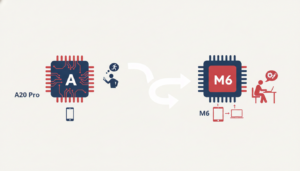
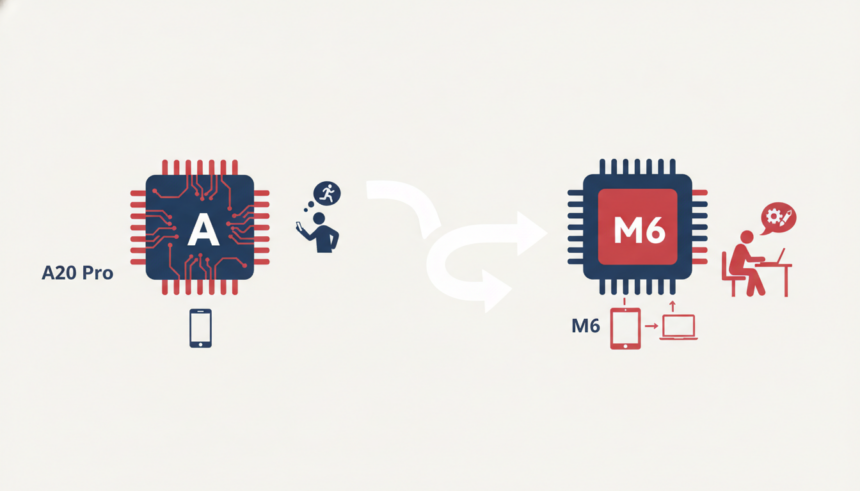
A20 Pro vs M6 is a comparison of two chips on the same TSMC 2nm N2 node with near-identical single-core performance. The A20 Pro runs 6 CPU cores and a 7-core GPU inside a 6W power budget; the M6 runs 12 CPU cores and a 12-core GPU at 30W. That produces roughly 79% more multi-core throughput for the M6, which sits in actively cooled machines while the A20 Pro works fanless.
The shared DNA is not marketing convenience. Both designs use the same Super core microarchitecture fabricated on N2, therefore instructions-per-clock are effectively matched and peak clocks land within a few percent of each other. The resulting gap is a function of core count and power budget alone — a deliberate engineering split, not a generational advantage for either chip.
That split only became a real buying decision in the last week of October. Until Apple shipped the M6 inside the 14-inch MacBook Pro and iMac on October 27, 2026, the M6 lived in a single desktop; now a buyer can reasonably weigh a phone, a tablet and a laptop against each other for the same creative work. The release order below explains how Apple got here.
A20 Pro vs M6: Core Specifications Compared
| Specification | Apple A20 Pro | Apple M6 |
|---|---|---|
| Process node | TSMC 2nm N2 (GAA nanosheet) | TSMC 2nm N2 (GAA nanosheet) |
| CPU cores | 6 (2 Super + 4 efficiency) | 12 (2 Super + 4 performance + 6 efficiency) |
| Peak CPU clock | Up to 4.93 GHz | Not stated |
| GPU cores | 7, with hardware ray tracing | 12 |
| Neural Engine | 32-core (dual 16-core) | Dual 16-core |
| Memory | 12 GB | 16 / 24 / 32 GB unified |
| Memory bandwidth | Not stated | 170 GB/s |
| Thermal design power | 6 W | 30 W |
| Cooling | Passive (fanless) | Active |
| Launch date | September 9–18, 2026 | August 25, 2026 |
| Primary devices | iPhone 18 Pro, iPhone Duo, OLED iPad mini | Mac mini, iMac, 14-inch MacBook Pro |
Apple’s 2026 2nm Rollout, in Order
- August 25, 2026 — M6 debuts in the new Mac mini, the first 2nm chip to market and the first time a new node launched on Mac before iPhone.
- September 9–18, 2026 — A20 Pro announced and shipped in the iPhone 18 Pro, iPhone 18 Pro Max and iPhone Duo.
- October 26, 2026 — OLED iPad mini arrives with the A20 Pro, with a binned 5-core version in the 128GB and 256GB models.
- October 27, 2026 — 14-inch MacBook Pro and iMac ship with the M6, rated at up to 24 hours of battery life.
What the Apple A20 Pro Actually Is: 6 Cores, 6 Watts, 32 Neural Cores
The Apple A20 Pro is a 6-core, 6-watt 2nm system-on-chip built for the iPhone 18 Pro and the OLED iPad mini. Its CPU pairs two “Super” high-performance cores clocked up to 4.93 GHz with four efficiency cores, and graphics come from a 7-core GPU carrying hardware-accelerated ray tracing plus embedded neural accelerators. The package ships with 12 GB of RAM, which is the ceiling that governs how large a project the chip can hold in memory.
The headline change is the Neural Engine, redesigned as a 32-core unit built from two 16-core blocks. That doubling exists because iOS 27’s new Siri experience and Apple Intelligence features execute on-device, which means inference latency and memory bandwidth matter more than raw CPU throughput for the features users notice. Research from the Stanford Institute for Human-Centered Artificial Intelligence documents the broader industry shift toward local inference for privacy and latency reasons — the same reasoning that pushes photographic workloads like AI-driven camera processing on recent iPhones onto the neural block rather than the CPU.
Packaging is the second structural change, and it is the one that affects how the chip behaves after five minutes of work. For the first time in an A-series part, Apple uses Wafer-Level Multi-Chip Module (WMCM) packaging, placing memory beside the processor die instead of stacking it on top. Because heat no longer has to escape through a memory layer sitting over the hottest part of the silicon, thermal dissipation improves and the chip holds boost clocks longer inside a fanless phone.
Apple claims the A20 Pro is 18% faster in CPU tasks and 30% more power-efficient than 2025’s A19 Pro. Read those two numbers together rather than separately: an 18% peak gain is modest, but a 30% efficiency gain in a 6W enclosure is what extends how long the chip can stay near peak. In practice that delivers longer sustained capture sessions and less mid-shoot slowdown, not dramatically higher benchmark ceilings.
Devices Shipping With the A20 Pro (October 2026)
- iPhone 18 Pro — full 6-core A20 Pro
- iPhone 18 Pro Max — full 6-core A20 Pro
- iPhone Duo — full 6-core A20 Pro
- OLED iPad mini 512GB — full 6-core A20 Pro
- OLED iPad mini 128GB and 256GB — binned 5-core A20 Pro
What the Apple M6 Actually Is: 12 Cores, 30 Watts, 170GB/s
The Apple M6 is a 12-core, 30-watt 2nm system-on-chip powering the Mac mini, iMac and 14-inch MacBook Pro. Apple’s August 2026 newsroom announcement lists two Super cores, four performance cores and six efficiency cores — two more cores in total than the M5 — alongside a 12-core GPU. Those two extra cores are the mechanical reason the M6’s multi-core score moves while its single-core score barely does.
Memory is configured as 16GB, 24GB or 32GB of unified memory running at 170 GB/s, up from the previous generation. Bandwidth, not core count, governs the workloads most professionals complain about: a multicam video timeline and a locally loaded language model both stream data faster than a CPU can be fed, therefore raising bandwidth to 170 GB/s does more for export times than another pair of cores would.
On the AI and connectivity side, the M6 carries a dual 16-core Neural Engine and adds Wi-Fi 7 and Bluetooth 6. Those radios arrive later than the silicon they sit beside because new wireless standards must clear accredited RF and electromagnetic compatibility testing — the kind performed by laboratories such as Micom Labs — before a device can ship. MacRumors’ M5 versus M6 MacBook Pro guide documents the October 27, 2026 14-inch MacBook Pro and iMac launch and the up-to-24-hour battery rating, a figure the 30W envelope makes achievable only because active cooling lets the chip drop to efficiency cores instead of throttling erratically.
Should an M5 owner move? Taking the gains below at face value, the honest answer is no for most people. A 1.2x multithreaded improvement is real but incremental, which means the upgrade pays for itself only where export or compile time is billed to a client. Buyers coming from an M3-era or Intel Mac see a far larger jump.
What the M6 Adds Over the M5
- Two additional CPU cores: 12 total versus the M5’s 10
- Up to 1.2x faster multithreaded CPU performance
- Up to 30% faster graphics from the 12-core GPU
- Up to 25% faster AI workloads on the dual 16-core Neural Engine
- Memory bandwidth raised to 170 GB/s with a 32GB maximum configuration
- Wi-Fi 7 and Bluetooth 6 replacing the previous generation’s radios
Why TSMC’s 2nm N2 Node Made Both Chips Possible
TSMC’s N2 process uses gate-all-around nanosheet transistors, in which the gate surrounds the channel on all four sides rather than wrapping three. That geometry gives the gate tighter electrostatic control over the channel, therefore current leakage falls and the same switching performance arrives at a lower operating voltage. Decades of federally funded nanoelectronics research — including work supported by the National Science Foundation — established the device physics behind that four-sided control before any foundry commercialised it.
That voltage reduction is the mechanism behind the A20 Pro’s claimed 30% efficiency gain and the M6 MacBook Pro’s 24-hour rating. It is also why Apple could field two 2nm chips in ten weeks while rivals waited: Apple reportedly secured more than half of TSMC’s entire 2nm production capacity for 2026, consequently it controlled the only meaningful supply of leading-edge wafers this year.
The commercially interesting point runs against the headlines. Mac revenue accounts for under 10% of Apple’s total earnings, therefore the M6’s bragging rights as the first 2nm chip to market carried little financial risk — if early N2 yields disappointed, the exposure was small. As analysts at Wccftech and supply-chain watchers have argued, it is the A20 Pro’s iPhone 18 Pro and iPad mini volume that actually amortises the cost of 2nm lithography. The M6 launched first precisely because it could afford to.
iPhone 17 Colors: Expected Variants and Themes
These gains are measurable rather than rhetorical, because node performance and AI compute claims are assessed against published measurement and benchmarking frameworks — an area the National Institute of Standards and Technology works on directly for AI systems. The same discipline applies to Apple’s component roadmap elsewhere in the phone, including its long-running in-house 5G modem programme.
A20 Pro vs M6 Benchmarks: Where the Gap Opens Up
Single-core performance in A20 Pro vs M6 is effectively tied: early Geekbench 7 results put the A20 Pro at roughly 4,006 and the M6 at roughly 4,071. Multi-core is where they separate, with the M6 at approximately 22,783 against the A20 Pro’s 11,460 — about 79% more throughput. Treat all four figures as early third-party Geekbench 7 runs rather than Apple-published numbers.
The cause is arithmetic, not architecture. The M6 fields double the CPU cores and roughly five times the power budget, which means every additional thread has both a core to land on and the watts to run it. Because both chips use the same Super core on the same node, the delta reflects a design decision about thermal envelopes rather than any generational edge.
Single-core parity has a practical consequence worth stating plainly: app launches, web page rendering and most camera processing feel identical on an iPhone 18 Pro and an M6 MacBook Pro. The gap appears only in work that genuinely scales across cores — compiles, renders, batch exports and parallel simulations.
One caveat governs everything above. Synthetic scores measure short bursts under favourable cooling, therefore they overstate what a fanless iPhone delivers across a ten-minute export. The thermals section resolves that gap.
Geekbench 7 Results: A20 Pro vs M6 (Early Testing, October 2026)
| Benchmark | A20 Pro | M6 | Difference |
|---|---|---|---|
| Geekbench 7 single-core | ~4,006 | ~4,071 | ~1.6% for M6 |
| Geekbench 7 multi-core | ~11,460 | ~22,783 | ~79% for M6 |
| CPU cores used | 6 | 12 | 2x for M6 |
| Thermal design power | 6 W | 30 W | 5x for M6 |
| Multi-core score per watt | ~1,910 | ~759 | ~2.5x for A20 Pro |
Real Workloads: Video, Code, Games and Local AI
Video capture goes to the A20 Pro; video post-production goes to the M6. Shooting 4K ProRes on an iPhone 18 Pro and cutting a single-stream edit on location is comfortably within the chip’s 12GB envelope. Multicam timelines and long exports are a different job, because they stream several high-bitrate sources at once — which is exactly what the M6’s 170 GB/s bandwidth and 32GB memory ceiling exist to serve.
Compiling code goes to the M6, decisively. Xcode builds are embarrassingly parallel, therefore they consume every core offered; the M6’s 12 cores finish large builds in roughly half the time six cores need. This is the clearest practical expression of the 79% multi-core gap, and it is why no amount of single-core parity makes a phone a build machine.
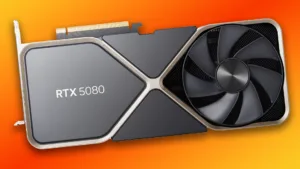
Mobile gaming goes to the A20 Pro; multi-display graphics go to the M6. The A20 Pro’s 7-core GPU with hardware ray tracing runs console-class titles including Resident Evil Village and demanding free-to-play games such as Genshin Impact at playable frame rates in a 6W envelope. The M6’s 12-core GPU targets a different problem entirely: driving multiple external high-resolution displays and sustaining heavy GPU compute, closer in spirit to the desktop graphics tier we examined in our RTX 5080 review.
On-device Apple Intelligence is a tie; larger local models go to the M6. The 32-core Neural Engine makes the A20 Pro strong at the small models behind Siri and system-level AI features. Larger local LLMs are a memory problem, not a compute problem — preprint research on local inference consistently finds throughput bound by available memory capacity and bandwidth rather than core count, which is why the M6’s 32GB unified memory matters more here than its extra cores. If your AI use is mostly cloud chat assistants, neither chip changes much; we have written separately about how heavy daily AI use affects behaviour.
Gaming News and Reviews – The Tech ABC
AV1 encoding goes to neither. Current reporting indicates both chips lack a dedicated hardware AV1 encoder, which means AV1 exports fall back to software rendering on iPhone, iPad and Mac alike. Treat it as a shared limitation rather than a tiebreaker.
Workload Verdicts at a Glance
- 4K ProRes capture on location — A20 Pro
- Multicam timelines and long video exports — M6
- Xcode builds and large project compiles — M6
- Mobile gaming with hardware ray tracing — A20 Pro
- Apple Intelligence and on-device Siri tasks — tie
- Local LLMs above a few billion parameters — M6 with 32GB unified memory
- AV1 encoding — neither; software rendering on both
Thermals Decide the Winner: Fanless Throttling vs Sustained Load
In A20 Pro vs M6, cooling rather than architecture determines which chip finishes a long job faster, because fanless iPhones and iPads must shed every watt through the chassis itself. An iPhone 18 Pro or OLED iPad mini dissipates heat passively, therefore clock speeds step down once the enclosure saturates — typically within minutes of continuous load. Peer-reviewed work on passively cooled mobile systems-on-chip, including studies published in the European Journal of Engineering and Computer Sciences, documents that pattern across architectures regardless of how efficient the silicon is.
The Mac mini, iMac and 14-inch MacBook Pro use active cooling, consequently the M6 holds peak multi-core clocks for as long as the job runs and the full 30W envelope is usable rather than theoretical. Research from the MIT Energy Initiative on the relationship between processor power draw, heat dissipation and battery runtime in consumer electronics explains both halves of this trade-off: a 6W part delivers all-day mobile endurance, and a 30W part requires a fan to realise its ceiling.
The A20 Pro’s WMCM packaging and the 2nm node’s lower operating voltage push the throttling point later than on the A19 Pro, which means mobile capture sessions run longer before clocks fall. Those same efficiency mechanics explain why iPhone battery life keeps improving generation over generation and why a chip’s advertised wattage tells you more about real performance than its clock speed does — a point we made earlier about how power budgets dictate actual throughput.
The rule that follows is short: buy for the cooling system, not the benchmark score.
Which Chip You Actually Need: The 2026 Buyer Verdict
Three profiles cover almost everyone. A mobile creator takes the A20 Pro, because capture and portability are the constraints. A professional developer or editor takes the M6, because sustained multi-core work is the constraint. Anyone already running an M5 Mac or an A19 Pro iPhone should skip this generation, because the gains do not justify the outlay.
For mobile creators, the A20 Pro inside the iPhone 18 Pro or the OLED iPad mini covers 4K ProRes capture, on-the-go editing, real-time AI translation and Apple Intelligence features without strain. The 6W envelope plus the 30% efficiency improvement over the A19 Pro delivers all-day battery, which matters more on a shoot than a multi-core score ever will.
For professionals, the calculus reverses. Compiling large projects, exporting multicam timelines, driving multiple external displays and loading local AI models all require cores, bandwidth and uninterrupted clocks, which means the 14-inch MacBook Pro or the Mac mini is the correct purchase rather than a very fast tablet. The 32GB unified memory option exists specifically for workloads the A20 Pro’s 12GB cannot hold.
If you already own an M5 Mac, the move to M6 buys roughly 1.2x multithreaded performance and a 170 GB/s memory bus. That is a genuine improvement and still a poor use of money outside time-billed professional work, where shaving minutes off every export compounds.
One buying trap deserves attention. The 128GB and 256GB OLED iPad mini models ship with a binned 5-core A20 Pro, consequently the 512GB model is the only configuration carrying the full 6-core chip. A storage choice silently changes CPU performance here, so anyone buying the iPad mini for sustained creative work should price the 512GB model from the start.
A20 Pro or M6: Decision Matrix by Buyer Profile
| If you are a… | Choose | Buy | Deciding factor |
|---|---|---|---|
| Mobile creator shooting ProRes on location | A20 Pro | iPhone 18 Pro | 6W battery endurance |
| Professional developer compiling large projects | M6 | 14-inch MacBook Pro | 12 cores, active cooling |
| Video editor with multicam timelines | M6 | Mac mini or MacBook Pro | 170 GB/s, 32GB memory |
| Mobile gamer wanting ray tracing | A20 Pro | iPhone 18 Pro | 7-core GPU, ray tracing |
| Local AI tinkerer running LLMs | M6 | Mac with 32GB unified memory | Memory capacity ceiling |
| Existing M5 Mac owner | Keep the M5 | Nothing this cycle | Only 1.2x multithreaded gain |
| Existing iPhone 17 Pro / A19 Pro owner | Keep the A19 Pro | Nothing this cycle | 18% CPU gain is incremental |
Frequently Asked Questions About the A20 Pro vs M6
What is the difference between the A20 Pro and the M6?
Both are TSMC 2nm chips with near-identical single-core speed. The A20 Pro has 6 CPU cores, a 7-core GPU and a 6W power budget for iPhones and the iPad mini. The M6 has 12 CPU cores, a 12-core GPU, up to 32GB of unified memory and a 30W budget for Macs, delivering roughly 79% more multi-core performance. The split is a deliberate thermal design choice rather than a generational gap.
Is the A20 Pro as fast as the M6?
In single-core tasks, yes — roughly 4,006 versus 4,071 in early Geekbench 7 testing, which means app launches and web browsing feel identical. In multi-core and sustained work, no: the M6 scores about 22,783 against the A20 Pro’s 11,460 because it has double the cores and five times the power budget. Active cooling widens that gap further over long jobs.
Which devices use the Apple A20 Pro chip?
The A20 Pro powers the iPhone 18 Pro, iPhone 18 Pro Max and iPhone Duo, launched September 9–18, 2026, plus the OLED iPad mini announced October 26, 2026. Note that the 128GB and 256GB iPad mini models use a binned 5-core version rather than the full 6-core chip. Only the 512GB iPad mini carries the complete CPU configuration.
Which Macs have the M6 chip?
The M6 debuted in the Mac mini on August 25, 2026, then arrived in the updated iMac and the 14-inch MacBook Pro on October 27, 2026. Apple rates the M6 MacBook Pro at up to 24 hours of battery life, because the 2nm node cut power draw per operation. The Mac mini remains the lowest-cost route to M6 performance.
Why did Apple launch the M6 before the A20 Pro?
Mac volumes are small, therefore launching 2nm on the Mac mini first limited Apple’s exposure to early N2 yield problems. Apple had reportedly secured more than half of TSMC’s 2026 2nm capacity, which meant the high-volume A20 Pro could follow roughly three weeks later once output stabilised. Mac revenue sits under 10% of Apple’s total, so the risk was contained.
Do the A20 Pro and M6 support AV1 encoding?
Neither chip includes a dedicated hardware AV1 encoder according to current reporting, which means AV1 exports fall back to software rendering on both platforms. Creators who publish in AV1 at volume should expect longer export times regardless of which chip they buy. Treat this as reporting rather than confirmed Apple documentation.
How many cores does the M6 have?
The M6 has 12 CPU cores: 2 Super cores, 4 performance cores and 6 efficiency cores, two more than the M5. It pairs those with a 12-core GPU and a dual 16-core Neural Engine, and supports 16GB, 24GB or 32GB of unified memory at 170 GB/s. The two added cores drive most of the multithreaded gain.
Is the A20 Pro good enough for video editing?
Yes for mobile work: 4K ProRes capture, single-stream cuts and colour grades run well within 12GB of RAM. No for heavy post-production, because the fanless iPhone and iPad chassis throttle under continuous export load. Multicam timelines and long renders need the M6’s active cooling and up to 32GB of unified memory. Match the chip to the length of the job.
How much faster is the M6 than the M5?
Apple quotes up to 1.2x faster multithreaded CPU performance, up to 30% faster graphics and up to 25% faster AI workloads, driven by two extra CPU cores and the 12-core GPU. That gain rarely justifies replacing a working M5 machine unless export or compile time is billable. Upgrading from M3-era hardware is a different calculation entirely.
What does TSMC’s 2nm process change for Apple chips?
N2 uses gate-all-around nanosheet transistors, where the gate surrounds the channel on all four sides. That reduces current leakage, therefore the same performance arrives at lower voltage. The practical results are Apple’s claimed 30% efficiency gain for the A20 Pro over the A19 Pro and the M6 MacBook Pro’s 24-hour battery rating. Density gains also allowed the extra cores in both designs.
Limitations of This Comparison and the Alternatives Worth Considering
The multi-core Geekbench 7 figures used here come from early third-party runs conducted within weeks of launch, therefore scores will shift as firmware and compilers mature. The reported absence of a hardware AV1 encoder in both chips rests on supply-chain reporting rather than Apple documentation, and we have labelled it accordingly throughout.
Scope is limited in a second way. Synthetic benchmarks and Apple’s own percentage claims measure different things under different conditions, consequently neither predicts performance inside a specific application such as Final Cut Pro or Xcode. Independent sustained-load testing on retail units remains thin this close to launch, which is precisely the data that would settle the thermal argument quantitatively.
Alternatives sit outside this two-chip comparison. The M5 Pro and M5 Max still outperform the base M6 in heavy multi-core work because they carry more performance cores, which means a discounted M5 Pro MacBook Pro is often the better export machine than a new M6 model at the same price. On the mobile side, the A19 Pro in last year’s iPhone delivers roughly 85% of the A20 Pro’s CPU speed, given Apple’s stated 18% generational gain, for less money.
Two future products would change the verdict: an M6 Pro or M6 Max in 2027, and any A-series or M-series chip that adds hardware AV1 encode. Either would reshape the recommendation for multi-core-heavy and AV1-heavy workflows.
The Bottom Line on Apple’s 2026 Silicon
A20 Pro vs M6 resolves into a single rule: the architecture is shared, the cooling is not, therefore buy for the sustained load your work actually imposes. Mobile creators get everything they need from the A20 Pro in an iPhone 18 Pro or OLED iPad mini. Developers and post-production editors need the M6’s cores, bandwidth and fan. Owners of an M5 Mac or an A19 Pro iPhone should sit this generation out.
Repeat the one trap worth memorising: the 128GB and 256GB OLED iPad mini models carry a binned 5-core A20 Pro, so the 512GB configuration is the only one with the full chip.
The larger dynamic shapes what arrives next. Because iPhone volume — not Mac volume — pays down the cost of 2nm lithography, the A20 Pro is the chip funding TSMC’s N2 ramp, and the speed of that ramp determines how aggressively Apple can push core counts and memory bandwidth in 2027. Read more semiconductor and tech analysis from The Tech ABC.
References
- Apple Newsroom — Apple introduces M6 and M5 Ultra for a big leap in performance and AI compute (manufacturer announcement, August 25, 2026)
- MacRumors — M5 vs M6 MacBook Pro buyer’s guide (industry publication, October 2026)
- National Institute of Standards and Technology — AI measurement and benchmarking programs (US standards body)
- National Science Foundation — funded research in nanoelectronics and advanced transistor architectures (US federal research funder)
- arXiv — preprint research on on-device large language model inference and memory constraints (academic preprint archive)
- Stanford Institute for Human-Centered Artificial Intelligence — research on on-device and local inference (academic research institute)
- European Journal of Engineering and Computer Sciences — peer-reviewed work on thermal throttling in passively cooled mobile systems-on-chip
- MIT Energy Initiative — research on processor power draw, heat dissipation and battery runtime (academic research institute)
- Micom Labs — accredited RF and electromagnetic compatibility testing (industry test laboratory)