
Table of Contents
- What Actually Changed: The FSR 4.1 Rollout to Older Radeon Hardware
- The INT8 Breakthrough That Made Backporting Possible
- Full Model vs Lite Model: Who Gets Which
- Radeon in 2026: Why FSR 4 on Older Cards Changes the Value Math
- Which Radeon Cards, APUs and Consoles Support FSR 4.1 Right Now
- Handhelds and Consoles: Where INT8 Upscaling Pays Off Most
- Should You Upgrade or Wait? A Five-Step Decision Framework
- Frequently Asked Questions
- Limitations, Caveats and Alternatives
- Conclusion
- References
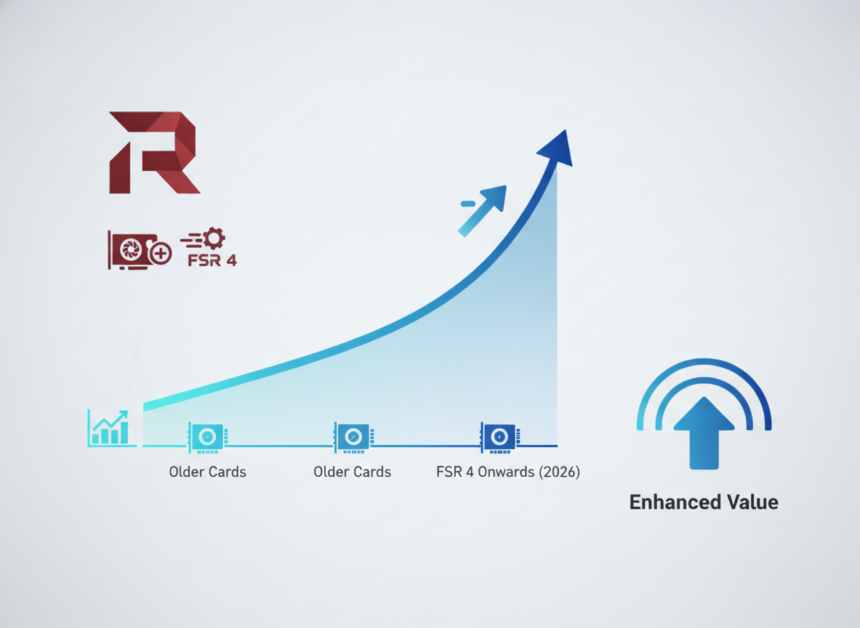
Radeon in 2026: Why FSR 4 on Older Cards Changes the Value Math comes down to one engineering decision. AMD rebuilt its machine-learning upscaler to run on INT8 shader hardware, therefore FSR 4.1 now works on Radeon RX 6000 (2020), RX 7000, Ryzen AI and Z2 APUs, and Xbox Series X|S. Tom’s Hardware measured roughly 13% overhead versus FSR 3 on an RX 6900 XT, which means older cards gain image quality close to native rendering without a purchase.
On October 20, 2026, AMD shipped Adrenalin Edition 26.10.1 and pushed FSR 4.1 onto Radeon RX 6000 series cards — hardware that first went on sale in 2020 — ahead of the company’s own stated 2027 timeline. The same driver extended support to Ryzen AI Max, Ryzen AI 9 and Ryzen Z2 handheld processors. That timing matters economically, because new graphics card prices climbed through 2026 under an AI-driven chip and memory supply crunch, resulting in a large pool of buyers who deferred upgrades rather than pay inflated prices. Radeon in 2026: Why FSR 4 on Older Cards Changes the Value Math is therefore not an abstract question about upscaling quality — it is a spending decision. This analysis covers the dated rollout timeline, the INT8 engineering that made the backport possible, the measured performance cost, the full list of supported hardware, and a five-step framework for deciding whether to upgrade at all.
About the author: Written by the tech trends and innovations desk at The Tech ABC, which covers GPUs, consoles and PC components with a focus on what a technology change costs and who it actually benefits.
The Tech ABC – Tech News, AI Insights & Smartphone Reviews
Transparency: Every performance figure in this article is attributed to the outlet or vendor that measured it. The Tech ABC did not run these benchmarks. Driver behaviour described here reflects releases current on November 20, 2026.
What Actually Changed: The FSR 4.1 Rollout to Older Radeon Hardware
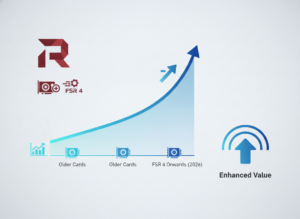
FSR 4 launched in 2025 as a Radeon RX 9000 exclusive, but two 2026 driver releases changed that: Adrenalin Edition 26.6.2 on June 22, 2026 brought FSR 4.1 to RX 7000 cards, and Adrenalin 26.10.1 on October 20, 2026 extended it to RX 6000 hardware. Microsoft and AMD then handed the technology to Xbox developers in early November.
FSR 4 rollout timeline, 2025 to November 2026
- 2025 — FSR 4 debuts as AMD’s first fully machine-learning-trained upscaler, exclusive to RDNA 4 Radeon RX 9000 cards using native FP8 matrix acceleration.
- June 22, 2026 — Adrenalin Edition 26.6.2 brings FSR 4.1 to RDNA 3 Radeon RX 7000 GPUs.
- October 20, 2026 — Adrenalin 26.10.1 extends FSR 4.1 to Radeon RX 6000, Ryzen AI Max, Ryzen AI 9 and Ryzen Z2 handheld chips, announced by AMD Senior Vice President and GM of the Computing and Graphics Group Jack Huynh.
- November 4, 2026 — Microsoft and AMD release FSR 4 to Xbox developers through the Microsoft Game Development Kit, covering the RDNA 2-based Xbox Series X and Series S.
- November 16, 2026 — AMD’s Unreal Engine plugin updates to FSR Upscaling 4.1.2, letting a single implementation cover RX 9000, RX 7000, RX 6000 and APUs.
The sequencing is the important part. Because AMD delivered RX 6000 support ahead of its own 2027 roadmap, the installed base of FSR 4-capable hardware expanded by millions of cards in a single driver cycle, which means studios now have a commercial reason to implement one modern upscaler path instead of maintaining FSR 3 fallbacks indefinitely. PCWorld’s Brad Chacos noted that gamers reacted angrily when FSR 4 was locked to the RX 9000 series at launch, and that shipping RX 6000 support early restored AMD’s reputation for open, consumer-friendly technology. That reputational swing has a practical consequence: driver adoption rises, which gives AMD more real-world telemetry and more leverage with developers in the mid-range tier where it sells the most silicon.
The INT8 Breakthrough That Made Backporting Possible
The original FSR 4 model ran on FP8 (8-bit floating point) data types that only RDNA 4 processes natively, therefore RDNA 2 and RDNA 3 cards were excluded by hardware capability rather than by a licensing decision. The barrier was arithmetic, not policy — older Radeon architectures simply have no FP8 path.
AMD’s fix was to requantise the neural network to INT8 (8-bit integer), a format that standard shader hardware executes without dedicated AI matrix accelerators. Consequently, the upscaler no longer depends on the matrix engines that distinguish RDNA 4 from its predecessors. This is an established technique rather than a vendor invention: published research on 8-bit post-training quantisation has documented for years that converting a trained network to integer arithmetic preserves most output fidelity while substantially raising throughput on general-purpose compute units, with a measurable and bounded accuracy trade-off. Work indexed in the European Journal of Engineering and Computer Sciences on efficient inference points the same direction — reducing numeric precision or parameter count trades reconstruction fidelity for speed, and the engineering question is how much fidelity you are willing to spend. National Science Foundation-funded research on accelerated computing architecture describes the underlying distinction clearly: general shader compute is flexible but slower per operation than a purpose-built matrix accelerator, which is why an INT8 fallback works at all and why it costs something.
AMD shipped two INT8 variants with the November 16, 2026 Unreal Engine 4.1.2 plugin update, documented through AMD’s GPUOpen developer resources. Integrated graphics and handheld chips have far less shader headroom than discrete cards, resulting in a Lite model under half the size of the full version.
| Model variant | Data type | Target hardware | Relative model size |
|---|---|---|---|
| FSR 4 original | FP8 | Radeon RX 9000 (RDNA 4) | Baseline full size |
| FSR 4.1 Full | INT8 | Radeon RX 7000, RX 6000, Ryzen AI Max | Full size |
| FSR 4 Lite | INT8 | Integrated graphics, thin-and-light laptops, Ryzen Z2 / Z2 Extreme | Under half of full |
Full Model vs Lite Model: Who Gets Which
The full INT8 model targets discrete RX 6000 and RX 7000 desktop cards plus high-end Ryzen AI Max processors, because those parts have the shader throughput to run the complete network inside a frame budget. The Lite model serves integrated graphics, thin-and-light laptops, Ryzen Z2 and Z2 Extreme handhelds and the Series S tier. Quality expectations should differ accordingly: a smaller network has fewer parameters to reconstruct detail with, therefore readers running Lite on a handheld should expect a meaningful improvement over FSR 3 rather than parity with an RX 9000 running the FP8 original.
Radeon in 2026: Why FSR 4 on Older Cards Changes the Value Math
Radeon in 2026: Why FSR 4 on Older Cards Changes the Value Math is a question of cost per frame, not raw silicon. A free driver update raises effective performance and image stability on hardware bought in 2020 at roughly a 13% overhead versus FSR 3, consequently resetting the baseline that any new card must beat to justify its price.
| Hardware | Test scenario | Reported result | Source |
|---|---|---|---|
| Radeon RX 6900 XT | Cyberpunk 2077, 4K Balanced | ~13% overhead vs FSR 3 | Tom’s Hardware |
| Radeon RX 6000 / RX 7000 | FSR 4.1 scaling presets | 10–70% higher frame rate | AMD / press testing |
| Xbox Series X | FSR 4 Lite at 4K | 2.75 ms GPU time per frame | Microsoft GDK (Claude Marais) |
| Xbox Series X | FSR 4 Full at 4K | 3.86 ms GPU time per frame | Microsoft GDK (Claude Marais) |
Tom’s Hardware’s Bruno Ferreira recorded the RX 6900 XT figure while also reporting that the shimmering on fine details that plagued earlier FSR versions largely disappeared. Read the trade honestly: the 13% is not a performance loss against native rendering, it is a slice taken out of the gain FSR 3 already delivered. Because the upscaler still renders far fewer pixels than native resolution, net frame rates land well above native while image stability improves — the cost buys quality rather than cancelling the speed.
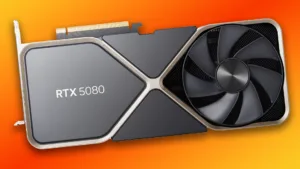
The economics compound that. GPU prices climbed through 2026 under AI-driven memory and wafer shortages, which means the marginal value of a new mid-range card fell at precisely the moment older Radeon cards got better. A buyer weighing a current flagship against a 2020 card is no longer comparing modern upscaling against none; our RTX 5080 review illustrates the price tier that an upgrade now has to beat, and the gap it must close has narrowed by a driver download. The rational response, for a large share of 1440p gamers, is to defer.
Which Radeon Cards, APUs and Consoles Support FSR 4.1 Right Now
FSR 4.1 support covers Radeon RX 9000, RX 7000 and RX 6000 desktop GPUs, Ryzen AI Max, Ryzen AI 9 and Ryzen Z2 class processors, and Xbox Series X|S through the developer toolkit.
FSR 4.1 eligibility checklist
- Radeon RX 9000 series (RDNA 4) — native FP8 path, supported since 2025
- Radeon RX 7000 series (RDNA 3) — INT8 full model, requires Adrenalin 26.6.2 or newer
- Radeon RX 6000 series (RDNA 2) — INT8 full model, requires Adrenalin 26.10.1 or newer
- Ryzen AI Max and Ryzen AI 9 processors — INT8 full model on higher-tier parts, Lite on constrained configurations
- Ryzen Z2 and Z2 Extreme handheld chips — FSR 4 Lite model
- Xbox Series X and Series S — available to developers through the Microsoft GDK since November 4, 2026, with per-game implementation required
- Unreal Engine titles — FSR Upscaling plugin 4.1.2 or newer covers all supported Radeon tiers with one integration
One practical caveat separates the PC and console experience. Console and engine-side support is developer-gated, which means an Xbox owner sees FSR 4 only in titles whose studios ship it, whereas PC users get driver-level access through Adrenalin as soon as they install the release. The Unreal Engine 4.1.2 plugin reduces that friction on the developer side, because a single integration now reaches RX 9000, RX 7000, RX 6000 and APU hardware instead of requiring separate code paths per architecture.
Handhelds and Consoles: Where INT8 Upscaling Pays Off Most
Handhelds gain the most from FSR 4.1 because they render at very low internal resolutions — 720p output to a 1080p panel is routine — and that is exactly where the older spatial and hand-tuned temporal upscalers degraded the image most visibly. Machine-learning reconstruction has more to contribute when there are fewer source pixels to work from, therefore the perceptual jump on a handheld is larger than the same model delivers on a 1440p desktop.
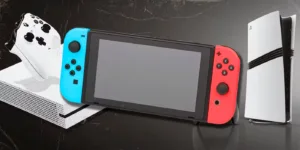
The console side follows the same logic with harder numbers. Claude Marais, Principal Software Engineering Lead for Team Xbox, confirmed FSR 4 availability in the Microsoft GDK alongside the per-frame GPU costs tabled above. A sub-three-millisecond cost for the Lite model at 4K on Series X leaves meaningful frame budget intact, which means developers can spend the remainder raising settings elsewhere — shadow resolution, draw distance, effects density — and still ship a cleaner image. The effect is a visual gain on six-year-old console hardware with no mid-generation revision required.
For portable PCs, ASUS ROG Ally class devices and Ryzen Z2 handhelds inherit the Lite model, therefore the practical ceiling for handheld gaming rose through a driver update rather than a new chip. That contrast is worth noting against the Nintendo Switch 2 approach, where modern upscaling arrived bundled with new silicon that owners had to buy outright.
Should You Upgrade or Wait? A Five-Step Decision Framework
Radeon in 2026: Why FSR 4 on Older Cards Changes the Value Math resolves into a simple rule — if your card is RX 6700 XT class or better and you game at 1440p, update the driver and re-test before you open a shopping tab. Spending on new hardware before measuring what the free update delivers is how buyers overpay in a constrained market.
How to decide, in order
- Install Adrenalin 26.10.1 or newer and confirm FSR 4.1 appears for your card before spending anything.
- Re-test your three most-played titles at your actual resolution with FSR 4.1 Quality, then Balanced, and record the frame rates.
- Check VRAM usage during those runs — if you are pinned at 8GB, the bottleneck is memory, not upscaling.
- Compare your measured frame rate against the cost per added frame of a new card at current 2026 prices.
- Upgrade only if ray tracing, VRAM or a specific display resolution target remains unmet after FSR 4.1 is enabled.
This Is Why Photoshop Isn’t Your Only Option Anymore
The exception is real and worth stating plainly: the upgrade case survives for ray-traced 4K and for VRAM-starved 8GB cards, because upscaling reconstructs pixels but does not create memory, which means texture streaming stalls and ray-tracing throughput limits persist regardless of FSR version. Those are silicon problems, and a driver cannot solve them.
Frequently Asked Questions
Does FSR 4 work on Radeon RX 6000 cards?
Yes. Adrenalin Edition 26.10.1, released October 20, 2026, enabled FSR 4.1 on RDNA 2 Radeon RX 6000 GPUs using an INT8 version of the model. This arrived ahead of AMD’s originally stated 2027 timeline, because the requantised network removed the FP8 hardware dependency. RX 6000 desktop cards run the full INT8 model rather than the smaller Lite variant reserved for handhelds and integrated graphics.
How much performance does FSR 4 cost on older Radeon GPUs?
Roughly 13% overhead versus FSR 3, based on Tom’s Hardware testing by Bruno Ferreira on a Radeon RX 6900 XT in Cyberpunk 2077 at 4K Balanced. That cost buys markedly better temporal stability and removes the shimmering on fine detail that affected earlier FSR versions. Because the renderer still outputs far fewer pixels than native 4K, net frame rates remain substantially above native rendering.
What is the difference between FSR 4 and FSR 4 Lite?
Model size and target hardware. The full INT8 model serves discrete Radeon RX 6000 and RX 7000 cards plus Ryzen AI Max processors. FSR 4 Lite is under half the size and targets integrated graphics, thin-and-light laptops and Ryzen Z2 handhelds, because those parts lack the shader headroom to run the full network inside a frame budget. Expect somewhat lower reconstruction fidelity from Lite.
Why was FSR 4 locked to the RX 9000 series at first?
Because the original model required FP8 math that only RDNA 4 handles natively. AMD later requantised the network to INT8, which runs on standard shader hardware, consequently removing the architectural barrier for RDNA 2 and RDNA 3. PCWorld’s Brad Chacos observed that the early backport restored consumer goodwill after the initial exclusivity drew criticism from RX 6000 and RX 7000 owners.
Is FSR 4.1 as good as Nvidia DLSS?
Close enough to change buying decisions, but not identical. Reviewers describe FSR 4.1 image quality as rivalling native resolution and competitive with DLSS, which is a meaningful shift from FSR 3. DLSS still runs on dedicated tensor hardware rather than general shaders. Results vary by game, scaling preset, and whether the Full or Lite model is in use, so test your own titles.
Does FSR 4 on Xbox Series X and S work in every game?
No — it is developer-implemented. Microsoft added FSR 4 to the GDK on November 4, 2026, which means each studio must integrate it per title. Adoption is realistic because the reported cost on Series X at 4K is 2.75 ms for Lite and 3.86 ms for the full model, leaving usable frame budget for other visual improvements.
Does FSR 4.1 reduce input latency or just improve image quality?
Will Gemini’s Imagen 3 Redefine Android Image Generation?
It improves image quality and raises frame rate, and the higher frame rate lowers latency as a side effect. FSR 4.1 upscaling is distinct from frame generation, therefore the reported 10–70% gains come from rendering fewer pixels rather than from inserted frames. That distinction matters because interpolated frames do not reduce input latency the way genuine render-rate increases do.
Limitations, Caveats and Alternatives
Treat the published numbers as directional rather than definitive. The overhead figures circulating in November 2026 come from a small set of games and cards, principally Tom’s Hardware’s Cyberpunk 2077 testing on an RX 6900 XT, therefore results on other engines and on lower-tier RX 6000 parts will differ. NIST guidance on machine learning evaluation makes the general point that model output quality requires standardised measurement across varied inputs before a single result can be generalised, and a single-title benchmark does not meet that bar. Independent laboratory practice, of the kind described by validation specialists such as Micom Labs, exists precisely because vendor claims need repeatable third-party confirmation.
Three further caveats apply. FSR 4.1 does not address VRAM shortages, CPU bottlenecks or weak ray-tracing throughput, which means 8GB card owners and heavy RT users still face hard ceilings. Per-game support depends on developer integration or a driver-level override, and Xbox support is entirely developer-gated. Driver behaviour and quality presets change between Adrenalin releases, so everything described here reflects drivers current on November 20, 2026.
What Are Gmail’s New Security Changes for 2.5 Billion Users?
Alternatives worth weighing: an RX 9000 or RTX 50-series upgrade for ray-traced 4K, lowering your target resolution, adding system memory, or simply waiting out the 2026 memory-driven price pressure. New hardware carries its own trade-offs — our reporting on RTX 5090 cables melting and on how many watts the RTX 5080 really needs covers two of them.
Conclusion
Radeon in 2026: Why FSR 4 on Older Cards Changes the Value Math comes down to AMD choosing engineering over segmentation. Requantising the FSR 4 network to INT8 removed the FP8 hardware barrier, therefore a card bought in 2020 gained machine-learning upscaling through a free driver, and consequently the performance a new GPU must deliver to justify 2026 pricing went up rather than down. For 1440p gamers on RX 6700 XT class hardware or better, the upgrade looks deferrable through at least the next product cycle — measure first, then decide. The honest limit stands: ray-traced 4K and 8GB VRAM budgets remain unsolved by any upscaler, because reconstruction cannot manufacture memory or ray throughput. For more on where GPUs, consoles and handhelds go next, read our ongoing gaming news and reviews coverage.
References
- AMD GPUOpen — FidelityFX Super Resolution technical documentation and Unreal Engine plugin 4.1.2 release notes: https://gpuopen.com/
- Tom’s Hardware (Bruno Ferreira) — FSR 4.1 testing on Radeon RX 6000, Xbox Series X|S and Ryzen AI processors: https://www.tomshardware.com/
- Microsoft — Xbox Game Development Kit FSR 4 support announcement (Claude Marais, Principal Software Engineering Lead, Team Xbox): https://www.microsoft.com/
- PCWorld (Brad Chacos) — commentary on AMD releasing RX 6000 FSR 4 support ahead of schedule: https://www.pcworld.com/
- arXiv — research on 8-bit integer post-training quantisation of neural networks for inference on general-purpose hardware: https://arxiv.org/
- European Journal of Engineering and Computer Sciences — peer-reviewed work on efficient inference and algorithmic optimisation: https://www.ejecs.org/
- National Institute of Standards and Technology — guidance on machine learning model evaluation and measurement practice: https://www.nist.gov/artificial-intelligence
- National Science Foundation — federally funded research on computer architecture and accelerated computing: https://www.nsf.gov/
- Micom Labs — independent test laboratory practice for consumer electronics performance validation: https://micomlabs.com/