
Table of Contents
- 1. Pro Trailer Hitch Assist lines up the ball for you
- 2. Transparent trailer view makes the trailer disappear
- 3. Onboard scales weigh the tongue before you drive
- 4. Google Maps routes that know your trailer's size
- 5. Trailer tire pressure and health on the dash
- 6. Hands-free highway driving with a trailer attached
- 7. EV range math and 7.2 kW of off-board power
- What's worth paying for
- Related Reading
As of November 2026, towing technology on new trucks and SUVs has moved from mirrors and a spotter to rear cameras, suspension sensors and trailer-aware software, with the 2026 Ford Super Duty’s Pro Trailer Hitch Assist as the headline example. Here are the seven upgrades actually shipping on 2025 and 2026 models, what each one does, and who should pay for it.
1. Pro Trailer Hitch Assist lines up the ball for you
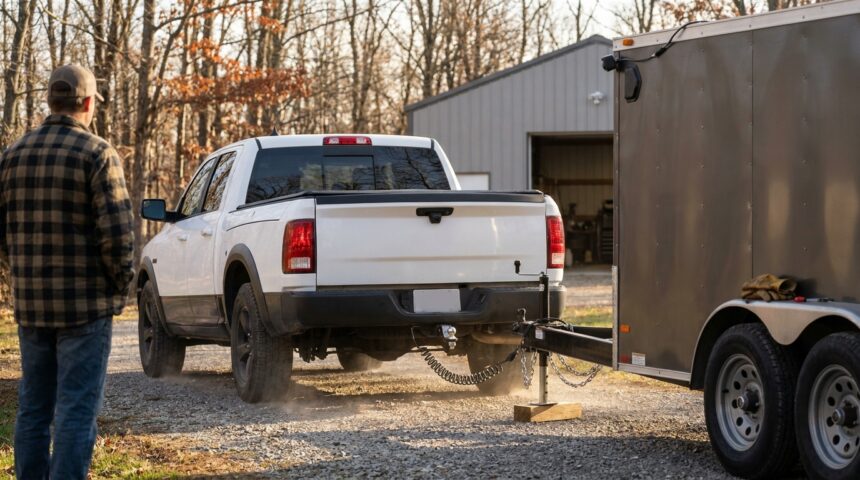
The truck reads the trailer coupler through its rear camera, then takes over steering, throttle and braking in reverse until the hitch ball sits underneath it. No spotter, no leaning out the window, no three-point shuffle.
Ford has rolled the feature across the 2026 F-150 and the 2026 Super Duty, according to Ford’s F-150 specs and features page. Ram offers its own Trailer Hitch Assist on the 2025 and 2026 Ram 1500. Trailer automation is maturing well outside pickups too: Toyota Industries said on October 30, 2026 that it is testing Level 4 autonomous towing tractors with Japan Airlines at Haneda Airport.
Buy it if you hitch alone in a driveway. Skip it if there’s always a second set of eyes behind the truck.

2. Transparent trailer view makes the trailer disappear
Transparent trailer view composites the tailgate camera feed with a second camera mounted on the back of the trailer, producing a single image that looks as though you can see straight through the trailer to the road behind it. It’s the only factory answer to the blind spot a 30-foot box creates.
GM leads here. Its November 2026 Silverado HD announcement lists up to 15 camera views on the 2025 and 2026 Chevrolet Silverado HD and GMC Sierra HD, covering conventional and fifth-wheel setups. Toyota is bringing comparable trailer camera and trailer-assist hardware to the segment with the 2027 Tundra.
One caveat the brochures bury: the trailer-mounted camera is an accessory purchase and has to be wired to the trailer. The headline camera count assumes you spent that money.
3. Onboard scales weigh the tongue before you drive
Suspension sensors read payload and tongue weight in real time, the cluster or phone app flags an unbalanced load, and you shift cargo in the driveway instead of discovering the problem as sway at 65 mph. That’s the whole value chain, and it’s short.
Ford fits Onboard Scales with Smart Hitch to the F-150 and the 2026 Super Duty, which tows up to 40,000 pounds with a gooseneck.
The NHTSA figures explain why this hardware exists rather than a sixteenth camera angle. Load balancing is the part drivers get wrong most often, and it is the part a scale fixes outright.
4. Google Maps routes that know your trailer’s size
Standard navigation ignores everything behind the hitch, which is how drivers end up at a 10-foot bridge with a 12-foot fifth wheel. A stored trailer profile changes the route calculation itself, steering around low clearances, weight-restricted bridges and switchbacks too tight to swing.
Setup takes a few minutes. You create the profile, enter the trailer’s length, width, height and loaded weight, then select it before you pull out. The 2025 Chevrolet Tahoe and Suburban added trailer route navigation through built-in Google Maps as part of a revised Max Trailering package, along with a boat ramp assist checklist that walks you through the launch sequence.
Full-size SUVs are the growth area for this. Toyota is pitching next-generation towing technology on the 2027 Sequoia, and buyers shopping the best SUVs for towing in 2026 should treat trailer-aware navigation as a package question, not a trim question.
5. Trailer tire pressure and health on the dash
An integrated trailer health monitor pairs the trailer’s tire pressure sensors and electrical diagnostics with the truck’s cluster. A slow leak shows up as a reading instead of ending as a blowout on an interstate shoulder, and a dead ground wire shows up before the lights go out.
The 2025 Ram 1500 displays its Integrated Trailer Health Monitor on a 12-inch digital cluster. The 2025 Chevrolet Tahoe adds a trailer tire health and load rating page inside its trailering app.
Honest comparison: an aftermarket trailer tire pressure monitoring system costs a fraction of the factory option and moves between trailers when you sell one. The trade-off is a second screen stuck to the windshield and another set of sensor batteries to replace. The factory version earns its price for one reason only, which is that the warning lands where you’re already looking.
6. Hands-free highway driving with a trailer attached
Super Cruise now works while towing, but only on mapped divided highways and only with the driver-attention camera watching your eyes. It is not a city feature and it never will be one.
The calibration is the real engineering. A loaded trailer stretches stopping distance well beyond the unladen case, so following gaps and brake ramp-up are retuned rather than inherited from the solo settings. Lane centering has to account for drag and the trailer’s yaw as well.
GM offers it on the 2025 Chevrolet Silverado EV and the top trims of Silverado HD and Sierra HD. Know the limits: no unmapped roads, no surface streets, and this towing technology does nothing about sway on its own. That job still belongs to trailer sway control and the integrated trailer brake controller.
7. EV range math and 7.2 kW of off-board power
Towing a heavy load roughly halves an electric truck’s usable range, which is why the range estimator matters more on an EV than any camera feature on this list. The software recalculates continuously from trailer weight, aerodynamic drag and the terrain ahead, updating as the load or the grade changes.
The 2025 Chevrolet Silverado EV LT tows up to 12,500 pounds with the Trailer Integration Package. Ford’s Pro Power Onboard puts out up to 7.2 kW on the F-150 hybrid and Lightning, enough to run an RV air conditioner off the truck at a campsite with no hookup.
Whether the Trailer Integration Package is worth its sticker depends on how you tow, and option pricing deserves the same scrutiny as any other spend — the same arithmetic we applied to what a tech paycheck actually buys in 2026.
For EV towing, charger spacing along your actual route decides the purchase. No option box fixes a 150-mile gap.
What’s worth paying for
Ranked by safety per dollar, the towing technology worth your money depends entirely on how often you hitch up: occasional boat haulers should pay for onboard scales and trailer tire monitoring and skip the rest; full-time RV owners get real value from transparent trailer view and trailer-aware navigation, because visibility and clearance are their daily problems; contractors dropping and collecting equipment several times a day will recover the cost of hitch assist in saved minutes. Budget for the accessory hardware too, since trailer cameras and sensors are extra and tech prices are climbing across hardware. The capability ceiling, not the software, still sets what each vehicle can pull.
Consumer Tech for Academic Research: Boost Your Workflow with Smart Devices
| Model | Max tow rating | Lead towing feature |
|---|---|---|
| 2026 Ford Super Duty | 40,000 lb (gooseneck) | Onboard Scales with Smart Hitch |
| 2026 Ford F-150 | 13,500 lb | Pro Trailer Hitch Assist |
| 2025 Chevrolet Silverado EV LT | 12,500 lb | Trailer Integration Package |
| 2026 Jeep Grand Wagoneer | 10,000 lb | Not stated |
| 2025/2026 Ford Expedition | 9,600 lb | Not stated |