
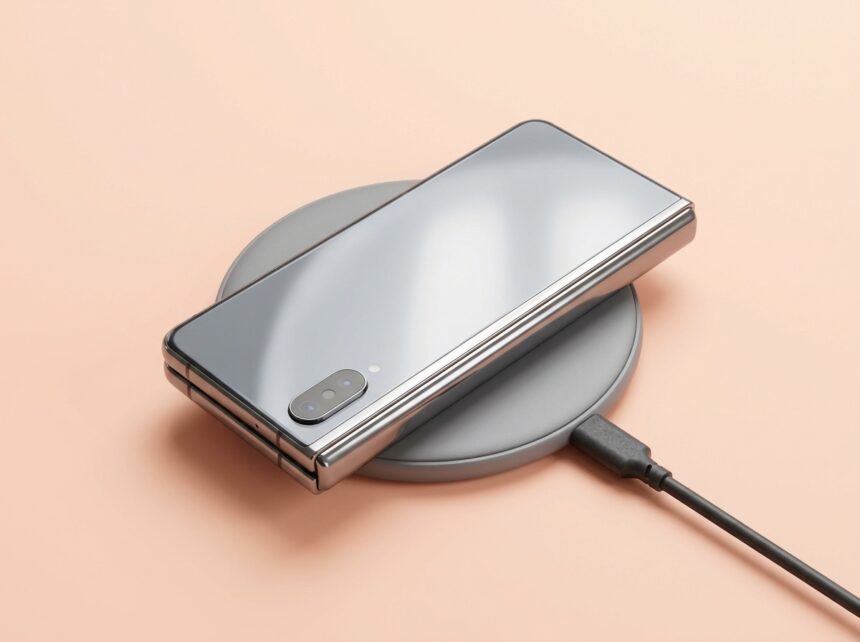
On November 22, 2026, Motorola’s upcoming Razr Flex 27 cleared the Wireless Power Consortium (WPC), confirming the book-style foldable will support 15W inductive charging. The regulatory filing for the device, codenamed XT2761, reveals that Motorola opted for the Qi2.2.1 standard using the Extended Power Profile (EPP) rather than the Magnetic Power Profile (MPP). This means the phone lacks built-in magnets for accessory alignment, a hardware decision driven by the device’s uniquely compact chassis and dense battery configuration.
Hardware Specs and the 15W Qi2 EPP Standard
The WPC certification confirms exactly how inductive charging works on the Razr Flex 27. By utilizing the Extended Power Profile (EPP) instead of the Magnetic Power Profile (MPP), Motorola excluded the internal magnetic ring found in Apple’s MagSafe ecosystem. Users who want to attach a magnetic charging pad will need a specialized, magnet-equipped protective case.
This charging hardware feeds a dual-cell 5,000 mAh battery, which is exceptionally large for a compact foldable. Leaks from TrustCB security documents indicate the device is powered by an unannounced Snapdragon 8 Gen 5 Pro chipset alongside 12GB of RAM. To complement the 15W wireless speeds, Motorola included 45W wired fast charging, resulting in competitive top-up times for heavy users.
The Push for a Compact Foldable Form Factor
Motorola capped the wireless charging speed at 15W because of strict thermal limits within the device’s compact footprint. Unlike the massive 7.6-inch tablet-style foldables currently dominating the market, the Razr Flex 27 features a 6.92-inch OLED inner display and a 4.97-inch cover screen. This shorter, wider aspect ratio makes the outer screen feel like a traditional smartphone.
Packing a 5,000 mAh battery and dual 50-megapixel camera sensors into this smaller chassis left no room for thick magnetic coils. Consequently, the engineering team prioritized battery capacity over magnetic accessory support, a trade-off designed to appeal to buyers who find current book-style foldables too heavy for daily use.
| Specification | Motorola Razr Flex 27 | Samsung Galaxy Z Fold 8 |
|---|---|---|
| Inner Display | 6.92-inch OLED | 7.6-inch |
| Outer Display | 4.97-inch OLED | Not stated |
| Battery Capacity | 5,000 mAh | Not stated |
| Expected US Price | $1,699 | $1,899 |
Industry Reaction to the Missing Magnets
Tech reviewers have met the WPC listing with mixed reactions. Analysts at Notebookcheck praised the compact design, noting it successfully targets consumers alienated by bulky hardware. However, the lack of MPP support has drawn criticism. Because the device relies on standard Qi inductive charging without magnetic alignment, buyers are locked out of a growing ecosystem of snap-on wallets and mounts unless they purchase a third-party case.
Despite this limitation, the aggressive pricing strategy is generating positive momentum. Expected to retail at $1,699 in the US and €1,500 in Europe, the Razr Flex 27 significantly undercuts the $1,899 Galaxy Z Fold 8, positioning it as a highly competitive entry point for book-style foldables.
January 2027 Launch and Market Impact
Motorola is preparing to officially unveil the Razr Flex 27 in January 2027, likely during the Lenovo Tech World presentation at CES. This early-year launch window allows Motorola to establish its compact foldable narrative months before Samsung and Apple announce their late-summer hardware refreshes. The device will ship with Android 17 out of the box, alongside Wi-Fi 7 and Bluetooth 6.0 support, ensuring its connectivity standards match its premium processor.
What is still unconfirmed
While the WPC certification locks in the charging specifications, several key details remain unverified. Early Geekbench scores pointed to a standard Snapdragon 8 Gen 5 processor, but newer security filings suggest a ‘Pro’ variant; Motorola has not confirmed which chip will power the retail units. The exact US carrier availability and potential trade-in promotions for the January launch are still unknown.
The exact processor tier (Snapdragon 8 Gen 5 vs Pro variant) and specific US carrier launch partners.
Related Reading
- Intelligent Agents on Your Own Devices: What They Actually Do on a Phone, Laptop, or PC
- Apple Intelligence Supported Devices in 2026: Which Apple Hardware Actually Runs It Well
- Microsoft Copilot Update: Wave 4 Features for Your Devices and Daily Workflow (October 2026)
- Apple 2026 Lineup, Explained: Every Device You Can Actually Buy Right Now