
Table of Contents
- Key Takeaways: Walmart Store Automation by 2026
- The Dawn of Automated Retail: Walmart's 2026 Vision
- About The Tech ABC Editorial Team
- Transparency & Ethics
- The Strategic Imperative of Walmart Retail Technology
- What is Proximity Retail Infrastructure?
- Walmart's Vision for Digital Transformation by 2026
- Micro-Fulfillment Centers: The Engine of Walmart's Local Delivery
- How Walmart Micro-Fulfillment Centers Work
- Impact on Last-Mile Logistics and 'Near Me' Services
- AI in Retail Logistics: Optimizing Walmart Supply Chain Automation
- AI for Demand Prediction and Inventory Management
- Machine Learning in Walmart Supply Chain Automation
- Building the Future: Walmart's Digital Infrastructure for Store Automation
- Cloud Infrastructure and Data Analytics for Stores
- Cybersecurity Measures for Advanced Retail Tech
- Enhancing the Customer Journey: Walmart Customer Experience Tech
- Personalized Shopping and In-Store Digital Signage
- Frictionless Checkout and Mobile App Innovations
- FAQ
- Limitations and Alternatives in Retail Automation
- The Automated Future of Proximity Retail
- References
- Related Reading
Key Takeaways: Walmart Store Automation by 2026
By 2026, Walmart’s strategic implementation of walmart store automation and advanced digital infrastructure fundamentally redefines proximity retail, consequently enhancing efficiency and customer experience. This transformation is driven by significant investments in robotics and AI, aiming for 65% of U.S. stores to be serviced by automated supply chains, resulting in improved inventory accuracy and reduced operational costs. The integration of micro-fulfillment centers, AI-driven logistics, and robust cybersecurity measures ensures faster local delivery and a seamless customer journey, positioning Walmart at the forefront of retail technology.
The Dawn of Automated Retail: Walmart’s 2026 Vision
The retail landscape is undergoing a profound transformation, driven by technological advancements. By 2026, Walmart, a global retail giant, is at the vanguard of this evolution, fundamentally reshaping how consumers interact with their local stores. This article delves into the intricate digital infrastructure powering walmart store automation, examining how the company’s aggressive adoption of AI, robotics, and advanced data analytics is creating a new paradigm for proximity retail. The urgency for this shift is underscored by Walmart’s ambitious target to have approximately 65% of its U.S. stores serviced by automated supply chains by the end of fiscal year 2026, as recently reported. This initiative directly impacts inventory accuracy, product flow, and significantly reduces average costs per unit by an estimated 20%, consequently setting new benchmarks for operational efficiency and customer satisfaction.
About The Tech ABC Editorial Team
This article was written by The Tech ABC Editorial Team, a group of experienced editors and tech analysts dedicated to providing expert, no-nonsense insights into the rapidly evolving world of technology. Our forward-looking analysis combines broad tech coverage with a specialized, authority-oriented approach, ensuring readers receive synthesis and interpretation beyond basic headlines. Read more about us.
The Tech ABC – Tech News, AI Insights & Smartphone Reviews
Transparency & Ethics
The Tech ABC is committed to journalistic integrity and ethical reporting. All information presented in this article is thoroughly researched and vetted against credible sources. We prioritize accuracy, clarity, and an unbiased perspective, aligning with the guidelines for ethical tech reporting. For more details, please review our Disclaimer and Privacy Policy.
The Strategic Imperative of Walmart Retail Technology
Walmart’s aggressive push into advanced retail technology is not merely an upgrade; it is a strategic imperative driven by evolving consumer expectations and intense market competition. The company’s focus on walmart store automation directly addresses the need for greater efficiency, speed, and personalization in a retail environment increasingly defined by e-commerce convenience. This strategic pivot ensures Walmart maintains its competitive edge, particularly in the proximity retail segment, by optimizing operations from supply chain to customer interaction.
What is Proximity Retail Infrastructure?
Proximity retail infrastructure encompasses the integrated systems and technologies that enable retailers to serve local customers with speed and precision. This infrastructure is crucial for ‘Walmart Near Me’ services, as it minimizes delivery times and enhances product availability, consequently driving customer satisfaction. Its effectiveness stems from a combination of localized operational hubs and intelligent backend systems.
Key Components of Proximity Retail Infrastructure
- Local distribution hubs designed for rapid dispatch
- Automated inventory systems for real-time stock visibility
- Data-driven demand forecasting tailored to local preferences
- Efficient last-mile delivery networks for quick fulfillment
Walmart’s Vision for Digital Transformation by 2026
Walmart’s digital transformation vision by 2026 centers on establishing a seamless, highly automated retail ecosystem. This ambitious plan is specifically designed to integrate advanced technologies across its operations, ultimately leading to significant improvements in efficiency and profitability. The company aims for 65% of its U.S. stores to be serviced by automated supply chains by the end of fiscal year 2026, a move expected to yield substantial operational benefits. This initiative directly addresses inefficiencies by leveraging robotics and AI, consequently enhancing in-stock inventory accuracy and flow. The expected outcome is a 20% reduction in average costs per unit, which translates into considerable savings and a stronger competitive position for Walmart.
Walmart’s Key Automation Targets and Impacts by FY2026
| Metric | Target by FY2026 | Impact on Operations |
|---|---|---|
| Stores serviced by automated supply chains | Approximately 65% of U.S. stores | Improved in-stock inventory accuracy, enhanced product flow |
| Average cost reduction per unit | About 20% | Lower operational expenses, increased profitability |
| Inventory accuracy and flow | Significantly improved | Reduced stockouts, fresher product availability |
Micro-Fulfillment Centers: The Engine of Walmart’s Local Delivery
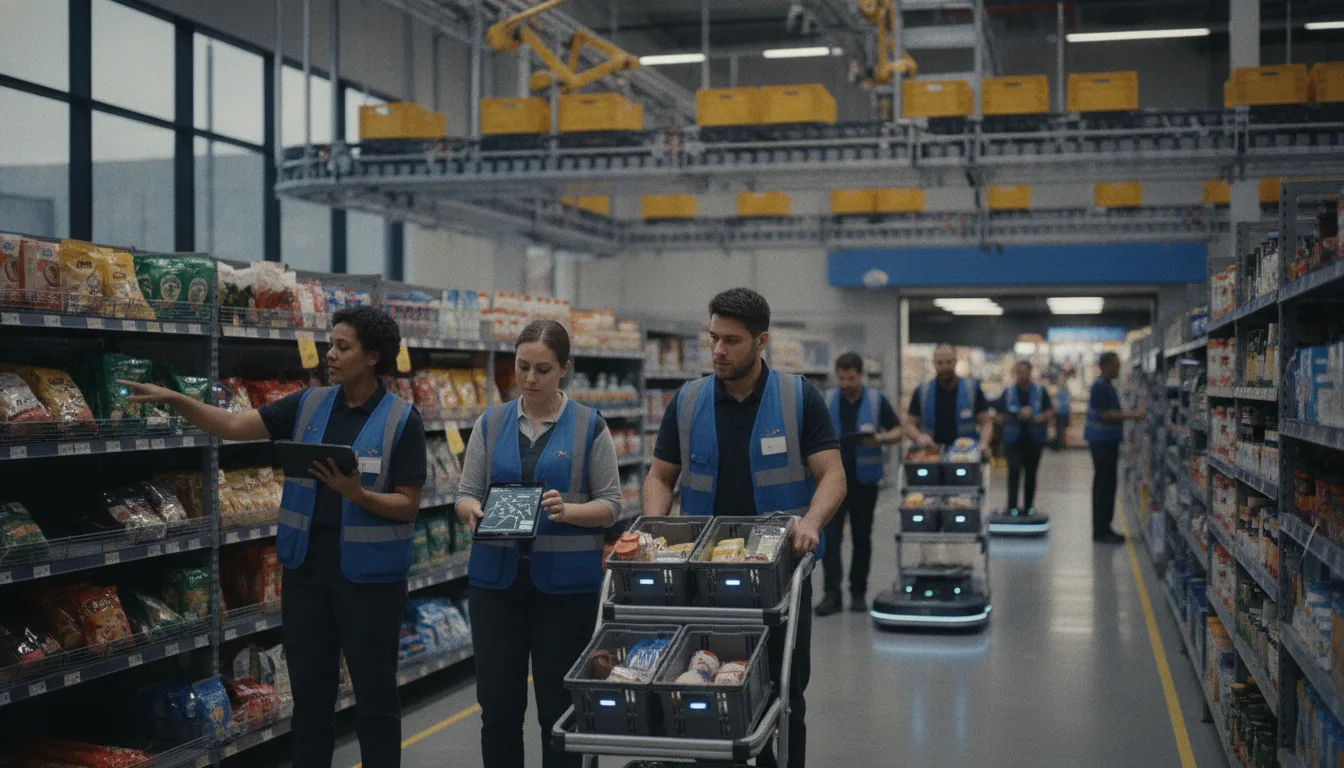
Walmart’s investment in micro-fulfillment centers (MFCs) represents a critical component of its strategy to dominate proximity retail. These compact, highly automated facilities, often situated within or adjacent to existing stores, serve as the engine for rapid local order fulfillment. The strategic placement of MFCs directly addresses the consumer demand for immediate gratification, consequently enabling faster pickup and delivery services. This localized automation significantly reduces the time and cost associated with traditional warehouse fulfillment, thereby improving the efficiency of last-mile logistics.
How Walmart Micro-Fulfillment Centers Work
Walmart’s micro-fulfillment centers operate with a streamlined, automated workflow designed for maximum speed and accuracy. When an online order is placed, it is immediately routed to the nearest MFC, initiating a sequence of robotic actions. This system minimizes human intervention, consequently reducing errors and accelerating the entire fulfillment process. The efficiency of this model allows Walmart to handle a high volume of orders rapidly.
Operational Steps in Walmart Micro-Fulfillment Centers
- Customer order placement triggers the system and routes to the closest MFC.
- Automated storage and retrieval systems (AS/RS) retrieve requested items from bins.
- Robotic arms or associates pick and consolidate items into designated order totes.
- Orders are packed, labeled, and staged for rapid dispatch for pickup or delivery.
Impact on Last-Mile Logistics and ‘Near Me’ Services
The integration of micro-fulfillment centers profoundly impacts Walmart’s last-mile logistics, creating a more responsive and cost-effective delivery network. By decentralizing inventory and bringing it closer to the customer, MFCs significantly reduce transportation distances and times. This localized approach directly translates into faster delivery for online orders and improved availability for ‘near me’ pickup services, consequently boosting customer satisfaction and loyalty. The efficiency gains also contribute to a reduction in operational costs, strengthening Walmart’s competitive position in the e-commerce sector.
Key Impacts of MFCs on Last-Mile Logistics
- Reduced delivery times for online orders and faster ‘near me’ pickups.
- Increased order accuracy due to automated picking processes.
- Lower operational costs by optimizing delivery routes and minimizing warehouse space.
- Enhanced customer satisfaction through convenience and speed of service.
AI in Retail Logistics: Optimizing Walmart Supply Chain Automation
Artificial Intelligence stands as a cornerstone of Walmart’s strategy for advanced supply chain optimization, directly complementing its broader walmart store automation initiatives. AI algorithms process vast datasets to identify patterns and predict future trends, consequently enabling more proactive decision-making across the logistics network. This technological integration ensures that products are precisely where they need to be, when they need to be there, minimizing waste and maximizing availability. The impact extends beyond simple forecasting, influencing every stage of the supply chain from procurement to final delivery.
AI for Demand Prediction and Inventory Management
AI-powered systems significantly enhance Walmart’s capabilities in demand prediction and inventory management. By analyzing historical sales data, seasonal trends, local events, and even real-time social media sentiment, AI generates highly accurate demand forecasts. This precision allows Walmart to optimize stock levels, consequently preventing both overstocking and costly stockouts. The result is a more agile and responsive inventory system that adapts dynamically to market fluctuations, directly improving product availability for customers and reducing financial waste.
AI’s Impact on Walmart’s Inventory Metrics
| Area of Impact | AI-Driven Improvement | Consequence for Operations |
|---|---|---|
| Demand Forecasting Accuracy | Enhanced precision, potentially up to 20% | Optimal stock levels, reduced carrying costs |
| Stockout Reduction | May reduce by up to 10% | Increased sales, improved customer satisfaction |
| Waste Minimization | Reduced spoilage/obsolescence | Lower operational costs, improved sustainability |
Machine Learning in Walmart Supply Chain Automation
Machine learning (ML) algorithms are integral to the advanced automation seen throughout Walmart’s supply chain. These systems learn from continuous data streams, enabling them to make increasingly intelligent decisions without explicit programming. From optimizing delivery routes to predicting equipment failures, ML drives efficiencies that were previously unattainable. This continuous learning capability ensures that the supply chain remains resilient and adaptable, consequently responding effectively to unforeseen challenges and opportunities.
Key Machine Learning Applications in Walmart’s Supply Chain
- Route optimization for delivery fleets, reducing fuel consumption and delivery times.
- Predictive maintenance for robotics and equipment in distribution centers, minimizing downtime.
- Supplier performance analysis to identify efficiencies and potential risks.
- Automated quality control checks for incoming goods, ensuring product standards.
Building the Future: Walmart’s Digital Infrastructure for Store Automation
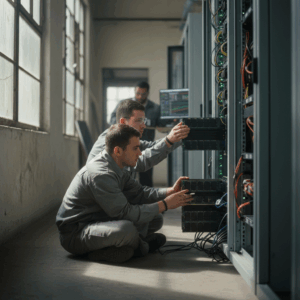
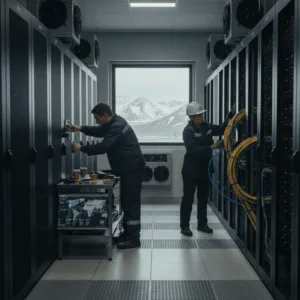
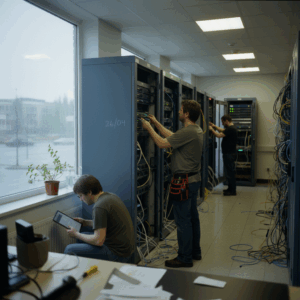
The ambitious scale of walmart store automation necessitates a robust and resilient digital infrastructure. This foundation comprises advanced cloud computing, sophisticated data analytics, and comprehensive cybersecurity measures, all working in concert to support a highly interconnected retail environment. Without this underlying digital backbone, the efficiencies gained from robotics and AI would be compromised. Walmart’s significant investment in these areas underscores its commitment to long-term technological leadership and operational excellence. For more on advanced digital infrastructure, explore The Tech ABC’s tech trends and innovations.
Cloud Infrastructure and Data Analytics for Stores
Cloud infrastructure provides the scalable and flexible computing power essential for managing the vast data generated by automated stores. This enables real-time processing of transactions, inventory updates, and customer interactions, consequently providing immediate insights for store managers. Data analytics platforms then transform this raw data into actionable intelligence, driving informed decisions on staffing, product placement, and promotional strategies. The synergy between cloud and analytics is paramount for optimizing in-store operations and personalizing the shopping experience.
Benefits of Cloud Infrastructure and Data Analytics in Stores
- Real-time operational insights for immediate decision-making.
- Scalability to handle peak demands and seasonal fluctuations.
- Enhanced data security and compliance across all store systems.
- Foundation for personalized customer experiences through data-driven insights.
Cybersecurity Measures for Advanced Retail Tech
With an expanded digital footprint due to automation, cybersecurity becomes a paramount concern for Walmart. Protecting sensitive customer data, proprietary operational algorithms, and critical infrastructure from cyber threats is non-negotiable. Consequently, Walmart invests heavily in advanced cybersecurity measures, including AI-powered threat detection and continuous monitoring. These defenses are designed to safeguard the integrity and availability of its automated systems, ensuring trust and operational continuity in an increasingly digital retail environment. For further reading on enterprise AI strategy and security, consider visiting AI Archives – The Tech ABC. The Cybersecurity and Infrastructure Security Agency (CISA) also offers valuable government recommendations on digital security and best practices for protecting critical infrastructure.
Key Cybersecurity Measures for Walmart’s Retail Tech
- Robust data encryption protocols for customer and operational data.
- AI-powered threat detection and anomaly identification systems.
- Regular security audits, penetration testing, and software updates.
- Comprehensive employee training on cyber hygiene and data protection best practices.
Enhancing the Customer Journey: Walmart Customer Experience Tech
The ultimate goal of walmart store automation extends beyond operational efficiency to fundamentally enhancing the customer journey. By leveraging technology, Walmart aims to create a more personalized, convenient, and seamless shopping experience both in-store and online. This customer-centric approach is crucial for fostering loyalty and attracting new shoppers in a competitive retail market. The integration of advanced digital signage, mobile app innovations, and frictionless checkout systems directly addresses common pain points and elevates the overall retail interaction.
Personalized Shopping and In-Store Digital Signage
Walmart is deploying advanced technologies to personalize the shopping experience, making each store visit more relevant and engaging. AI algorithms analyze purchase history and browsing behavior to offer tailored product recommendations, consequently guiding customers through the store more efficiently. Interactive digital signage provides dynamic information, promotions, and wayfinding assistance, directly improving navigation and discovery. This personalized approach aims to create a more satisfying and efficient shopping environment, reflecting individual preferences.
Innovations in Personalized Shopping and Digital Signage
- AI-driven product recommendations based on individual shopping patterns.
- Interactive digital displays providing dynamic product information and promotions.
- Geofencing technology for targeted mobile alerts and in-store offers.
- Seamless integration with the Walmart mobile app for personalized shopping lists and navigation.
Frictionless Checkout and Mobile App Innovations
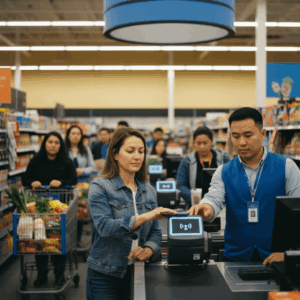
Eliminating friction at checkout is a key focus for Walmart, as it directly impacts customer satisfaction and reduces wait times. Innovations like scan-and-go technology and automated self-checkout kiosks expedite the purchasing process, consequently freeing up associates for more value-added tasks. The Walmart mobile app further enhances this experience by integrating payment options, order tracking for pickup, and personalized services. These advancements collectively create a more convenient and efficient transaction experience, reinforcing customer loyalty.
Frictionless Checkout and Mobile App Innovations
- Scan-and-go technology for self-scanning items via mobile app.
- Automated self-checkout kiosks with enhanced payment options.
- Mobile payment integration for quick and secure transactions.
- App-based order tracking and seamless in-store or curbside pickup options.
FAQ
How does Walmart use automation in its stores by 2026?
By 2026, Walmart extensively uses automation through robotics for tasks like shelf scanning, inventory management, and floor cleaning. Micro-fulfillment centers (MFCs) within or near stores automate online order picking and packing. This widespread walmart store automation aims to streamline operations, reduce manual labor, and enhance efficiency, with targets like 65% of U.S. stores serviced by automated supply chains. This shift consequently frees up associates for customer-facing roles, improving overall service and speed.
What is the digital infrastructure supporting Walmart’s proximity retail?
Walmart’s proximity retail is supported by a robust digital infrastructure, comprising cloud-based platforms for scalable data processing and storage, advanced data analytics for real-time insights, and sophisticated AI algorithms. This infrastructure enables efficient micro-fulfillment centers, powers personalized shopping experiences, and ensures seamless integration between online and in-store operations. Strong cybersecurity measures are also integral, protecting this expanded digital footprint and customer data, consequently ensuring operational continuity and trust.
How do micro-fulfillment centers enhance Walmart’s local delivery?
Micro-fulfillment centers (MFCs) significantly enhance Walmart’s local delivery by bringing inventory closer to the customer, consequently reducing last-mile logistics distances and times. These automated hubs quickly process online orders using robotics for picking and packing. This localized efficiency allows for faster order fulfillment, enabling quicker home deliveries and more convenient ‘near me’ pickup options. The result is improved speed, accuracy, and reduced operational costs for local delivery services.
What are the key technologies driving Walmart’s supply chain automation?
Walmart’s supply chain automation is primarily driven by Artificial Intelligence (AI) and Machine Learning (ML). AI optimizes demand prediction and inventory management, ensuring optimal stock levels and reducing waste. ML algorithms enhance route optimization for delivery, facilitate predictive maintenance for robotic systems, and improve supplier performance analysis. Robotics in distribution centers and micro-fulfillment centers also play a crucial role, automating tasks like sorting, picking, and packing, consequently boosting overall efficiency and reducing human error across the supply chain.
How does AI improve inventory management and demand prediction at Walmart?
AI significantly improves inventory management and demand prediction at Walmart by processing vast datasets, including historical sales, market trends, and even local events. This enables highly accurate forecasting of consumer demand, consequently allowing Walmart to optimize stock levels and minimize both overstocking and costly stockouts. AI-driven insights ensure products are available when and where customers want them, reducing waste and improving product flow. This precision directly enhances operational efficiency and customer satisfaction.
What benefits does Walmart’s store automation provide to customers and operations?
Walmart’s store automation delivers substantial benefits to both customers and operations. For customers, it means faster service, increased product availability due to improved inventory accuracy, and more personalized shopping experiences. Operationally, automation leads to significant cost reductions (up to 20% per unit), enhanced efficiency across supply chains, and reduced manual labor, consequently allowing associates to focus on higher-value tasks. This strategic investment boosts overall productivity and strengthens Walmart’s competitive position.
How is Walmart leveraging data analytics for a better ‘near me’ experience?
Walmart leverages data analytics to create a superior ‘near me’ experience by gaining real-time insights into local consumer preferences, inventory levels, and operational performance. Analytics help optimize product assortments for specific store locations, personalize promotions, and streamline order fulfillment from micro-fulfillment centers. This data-driven approach ensures that local stores are stocked with relevant items and services are tailored to immediate community needs, consequently enhancing convenience and customer satisfaction for local shoppers.
What are Walmart’s future plans for retail technology by 2026?
By 2026, Walmart plans to solidify its position as a leader in retail technology, with a major focus on expanding store and supply chain automation. Key plans include achieving 65% automation in U.S. stores’ supply chains, further integrating AI for predictive analytics, and enhancing digital infrastructure for seamless omnichannel experiences. The company aims to refine customer experience through personalized shopping and frictionless checkout. These initiatives are designed to drive efficiency, reduce costs, and meet evolving consumer demands, ensuring long-term growth.
What role do robotics play in Walmart’s in-store automation strategy?
Robotics play a pivotal role in Walmart’s in-store automation strategy by performing repetitive and labor-intensive tasks. This includes robots that scan shelves for inventory accuracy and misplaced items, automated floor cleaners, and robotic systems within micro-fulfillment centers for picking and packing online orders. The deployment of robotics directly improves operational efficiency, reduces human error, and allows human associates to focus on more complex customer service roles, consequently enhancing overall store productivity and customer experience.
How does Walmart ensure cybersecurity for its expanded digital infrastructure?
Walmart ensures robust cybersecurity for its expanded digital infrastructure through a multi-layered approach. This includes implementing strong data encryption protocols for sensitive information, deploying AI-powered threat detection systems for real-time monitoring, and conducting regular security audits and penetration testing. Furthermore, comprehensive employee training on cyber hygiene is crucial. These proactive measures are designed to protect against cyber threats, safeguard customer data, and maintain the integrity and availability of its advanced retail technologies, consequently building and maintaining customer trust.
Limitations and Alternatives in Retail Automation
While walmart store automation offers significant advantages, it also presents inherent limitations and considerations. High initial capital investment for robotics and AI infrastructure poses a substantial barrier, potentially slowing wider adoption for smaller retailers. Furthermore, the reliance on complex technological systems introduces new vulnerabilities, such as potential system failures or cyber-attacks, which could disrupt operations. The ethical implications of job displacement due to automation also require careful consideration, necessitating robust retraining and redeployment strategies for the workforce. Alternative approaches for retailers include phased automation, focusing on specific high-impact areas rather than a full overhaul, or leveraging third-party logistics and software-as-a-service (SaaS) solutions to reduce in-house development costs. Human-centric hybrid models, where technology augments rather than replaces human roles, also offer a balanced pathway for sustainable growth, consequently mitigating some of the social and operational risks associated with full automation.
The Automated Future of Proximity Retail
By 2026, Walmart’s strategic embrace of walmart store automation fundamentally reshapes the future of proximity retail. Through its sophisticated digital infrastructure, micro-fulfillment centers, and AI-driven logistics, Walmart is setting new benchmarks for efficiency, speed, and customer experience. The company’s commitment to having 65% of its U.S. stores serviced by automated supply chains demonstrates a decisive move towards a more resilient and responsive retail model. This transformation, driven by technological innovation and a clear vision, consequently positions Walmart as a leader in leveraging advanced tech to meet the evolving demands of the modern consumer, solidifying its competitive advantage in the years to come.
References
- National Institute of Standards and Technology (NIST). https://www.nist.gov/artificial-intelligence
- Cybersecurity and Infrastructure Security Agency (CISA). https://www.cisa.gov/
- Stanford Institute for Human-Centered Artificial Intelligence (HAI). https://hai.stanford.edu/
- National Science Foundation (NSF). https://www.nsf.gov/
- European Journal of Engineering and Computer Sciences. https://www.ejecs.org/
- arXiv. https://arxiv.org/
- Lawfare. https://www.lawfaremedia.org/
- Society of Professional Journalists. https://www.spj.org/