
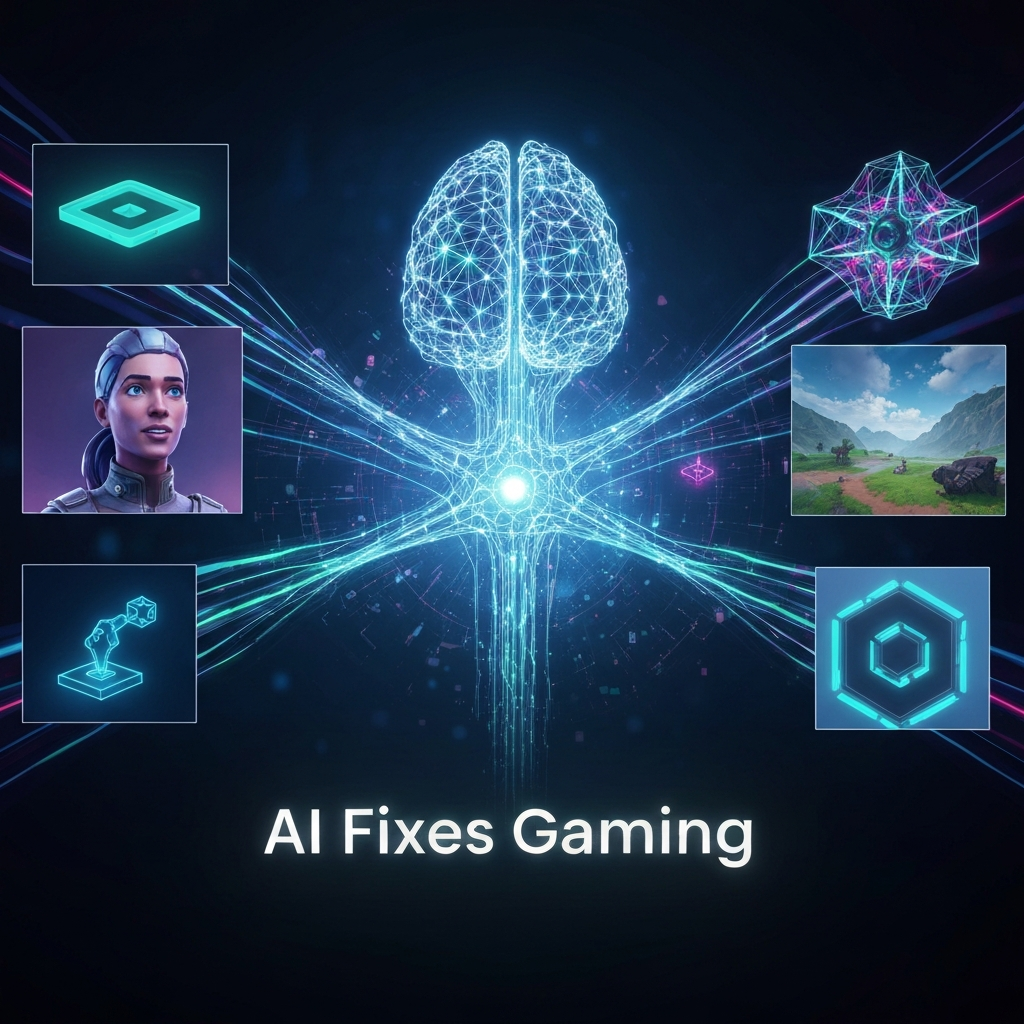
Are you tired of video game characters who walk in circles repeating the same line of dialogue? Frustrated by endless loading screens that pull you out of the action? For years, these problems have felt like an unavoidable part of the experience. But a revolution is underway, and it's powered by artificial intelligence. We're not talking about the simple, scripted 'AI' that has governed enemy patterns for decades. We're talking about modern, machine-learning-driven AI that is actively solving the most common and persistent frustrations for players. This article breaks down the 5 biggest problems in gaming and reveals the specific AI technologies that are creating more realistic, responsive, and immersive worlds right now. Forget what you thought you knew about AI in gaming; the real change is here.
The Core Problems: 5 Player Frustrations AI is Fixing
For decades, certain issues have been accepted as just 'part of gaming'. But as technology evolves, so do our expectations. Here are five of the most common gaming problems that Modern AI is finally solving.
| Player Frustration | AI-Powered Solution |
|---|---|
| Lifeless Worlds & Repetitive NPCs Game environments feel static and predictable when characters walk the same paths and repeat the same lines of dialogue. |
Dynamic Character AI: NPCs are given unscripted goals and can react to player actions and world changes, creating emergent narratives and making environments feel genuinely alive. |
| Endless Loading Screens & Laggy Performance Even on high-end hardware, players experience long load times and frame drops that break immersion. |
AI-Powered Rendering (e.g., DLSS): Deep learning models upscale lower-resolution images in real-time, dramatically boosting frame rates and performance without a noticeable loss in visual quality. |
| Stale, Predictable Content After a few hours, players have seen all the enemy types, dungeon layouts, and quest variations a game has to offer. |
Advanced Procedural Content Generation (PCG): Generative AI creates unique and endless content beyond just maps, including dynamic questlines, new items, and even original music to ensure high replayability. |
| Unbalanced Difficulty & Tedious Testing Games are often too easy or unfairly difficult, and massive worlds are prone to bugs that ruin the experience. |
Automated Testing & Adaptive Difficulty: AI agents play the game thousands of times to find bugs. The game can also analyze player skill to subtly adjust difficulty for a consistently engaging challenge. |
| Robotic, Uninspired Dialogue Conversations with game characters feel like clicking through a spreadsheet, lacking natural flow and nuance. |
Generative AI Dialogue Systems: Large Language Models (LLMs) enable NPCs to have dynamic, unscripted conversations that are aware of game lore and player context, moving beyond pre-written dialogue trees. |
Is It 'True AI' or Just Clever Coding?
The term AI in gaming has been used for decades, but its meaning has changed dramatically. It's crucial to understand the distinction between the old methods and the new frontier of machine learning.
The Difference Between Game AI and Machine Learning
For a long time, 'game AI' simply meant scripted logic. An enemy guard's patrol route or a boss's attack pattern wasn't intelligence; it was a pre-programmed set of `if-then` statements. This is fundamentally different from modern machine learning. The key difference between game AI and machine learning is that ML models can learn and adapt from data. This is real AI learning in video games—systems that can improve their performance, predict player behavior, or generate novel content without being explicitly programmed for every single possibility. This is true AI.
Current AI Limitations in Gaming
While the potential is enormous, there are still AI limitations in gaming. The computational cost of running complex machine learning models in real-time can be high, impacting performance. There's also the challenge of control; a truly intelligent and unpredictable AI can sometimes break a game's carefully designed narrative or balance. Developers are actively working on finding the right blend of scripted control and emergent intelligence to create experiences that are both dynamic and cohesive.
As these technologies mature, they will become even more integrated into the core of ai game development. The solutions they provide are not just incremental improvements; they are fundamentally changing what's possible in interactive entertainment. These advancements are a key part of the latest gaming trends, shaping a future where game worlds are more intelligent, responsive, and alive than ever before.
---
About the Author: Hussam Muhammad Kazim is an AI Automation Engineer with 3 months of experience, passionate about the intersection of artificial intelligence and interactive entertainment.
Frequently Asked Questions
What is the difference between game AI and real AI?
Traditional 'game AI' refers to scripted behaviors and decision trees, where an NPC follows a set of pre-programmed rules. 'Real AI' or machine learning involves systems that can learn from data, adapt their behavior, and make decisions in situations they weren't explicitly programmed for. The key difference is learning and adaptation versus following a fixed script.
How is AI used in game development?
AI is used across the entire development pipeline. Key applications include:
- Procedural Content Generation (PCG): Creating vast and unique game worlds, levels, and assets.
- NPC Behavior: Developing more realistic and dynamic characters that react intelligently to the player.
- Performance Optimization: Using technologies like NVIDIA DLSS to improve frame rates and resolution.
- Game Testing: Deploying AI agents to play the game and automatically detect bugs and glitches.
- Adaptive Systems: Creating dynamic difficulty and personalized player experiences.
Will AI tools replace game developers?
No, it is highly unlikely that AI will replace game developers. Instead, AI is becoming a powerful tool that augments their abilities. An AI game maker or game creator online can help a solo developer or small team create assets and code more efficiently, but it doesn't replace the need for human creativity, design vision, and storytelling. AI handles the tedious tasks, freeing up developers to focus on the creative ones.